TL; DR
Professional tax in India is a small state-level tax deducted from the salary of employees. Each state sets its own slabs, and the total never crosses ₹2,500 a year. This guide covers what professional tax is, how it hits your salary slip, how it differs from income tax, the rules employers must follow, and how to pay, verify, and check your professional tax status without the guesswork.
If you are a salaried working professional in India, there is a certainty that you might receive salary slips before the actual salary credits in your account. This salary slip is distributed 3 to 4 days prior to the salary disbursement.
The slip contains everything – your bank account number, PF account number, UAN number, ESIC number, PAN number, your working days, the leaves you took – everything is there. Now, there is one section: deductions. If you look carefully at it, at the top is often Professional Tax. In India, it is one of the most essential components of statutory compliance. This is imposed by the state government, and it varies from state to state.
But what exactly is professional tax, and why is it important? This guide breaks everything down and tells you everything you need to know.
What is professional tax: An overview
In India, PT, also known as professional tax, is a state-level tax that state governments levy on salaried employees and working professionals. Professional tax in India is applicable to individuals who meet the prescribed income limits in states that levy the tax.
Here’s what makes this tax unique:
- It is the only direct income tax collected by states under Article 276 of the Constitution.
- The maximum annual amount a state can legally charge is strictly capped at ₹2,500 per individual.
- The name is a little misleading. You don’t need to be a “professional” to pay it. If you draw a salary above your state’s threshold, you pay professional tax. Full stop.
- This tax is not standard across the nation; some states levy it using completely different income slabs, while states like Rajasthan do not charge it at all.
How does the professional tax deduction on salaries work?
For salaried employees, professional tax on salary is deducted automatically. You never have to file or pay for it yourself.
Let’s understand the process of how it works:
- The employer calculates the tax based on gross salary, withholds it each month, and deposits it with state authorities. It appears on your monthly payslip as “Professional Tax” or “PT.”
- Rates vary by state and are determined by professional tax slabs based on income brackets. The professional tax amount deducted from your salary therefore depends on your income and the rules prescribed by the respective state. For instance, in Gujarat, salaries up to ₹12,000 per month have a nil rate, while salaries above ₹12,000 attract a deduction of ₹200 per month. As discussed above, some states do not levy PT.
- The professional tax amount you pay during the year can be claimed as a deduction from your gross total income under Section 16(iii) of the Income Tax Act (the old tax regime).
Note: It is important to highlight that the exact amount of the tax depends on the state. Hence, if you want the exact figure for your city or state, run your salary through our Professional Tax calculator.
Difference between professional tax and income tax?
In India, more often than not, employees start to consider professional tax as a kind of or as a part of, the income tax. But that is not the case. Hence, we decided to clear the air once and for all.
| Basis | Professional Tax | Income Tax |
|---|
| Levied by | State government. | Central government. |
| Applies to | Salaried employees, professionals, traders. | All taxpayers with income above the exemption limit. |
| Maximum amount | Capped at ₹2,500 per year. | No fixed cap; based on income slabs. |
| Governing law | Separate Act for each state. | Income Tax Act, applicable nationwide. |
| Deduction | Fixed slab, deducted monthly. | Percentage-based, calculated annually. |
| Exempted regions | Not levied in states like Delhi, Haryana, UP, Rajasthan, Punjab, J&K, Himachal Pradesh, Uttarakhand, and Goa. | Applied everywhere. |
Professional tax rules every employer should be aware of!
If you evaluate the most common payroll mistakes of companies, you will realize it is often in the calculation of professional tax. This is especially true for companies that have offices in multiple states. Here’s what employers need to stay on top of:
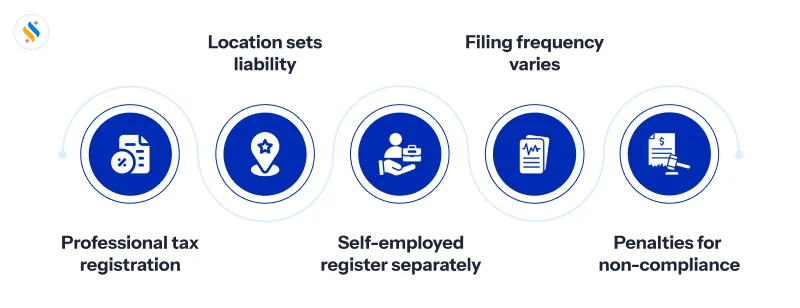
Professional registration is mandatory:
Any business with employees in a PT-levying state must register for a Professional Tax Registration Certificate (PTRC), typically within 30 days of hiring the first employee there.
Applicability follows the work location, not the head office:
A company registered in Delhi still owes Uttar Pradesh professional tax for employees working out of a Noida branch.
Self-employed professionals register separately:
Doctors, consultants, freelancers, and other self-employed professionals may need a Professional Tax Enrollment Certificate (PTEC) and must pay professional tax directly to the state government rather than through an employer.
Filing frequency varies by state:
Most states collect monthly. Tamil Nadu and Kerala use half-yearly cycles instead.
Penalties are real:
Late registration, late deduction, or late deposit can trigger fines and interest, and they add up fast across a multi-state workforce.
For any HR team managing employees across two or more states, this is exactly where things get messy without the right payroll software.
Stop tracking state-wise PT slabs in spreadsheets!
Choose a smart solution and simplify PT compliance for your business
Benefits of professional tax that you should know about
Yes, you have read it right – a tax can come with benefits. Here’s what professional tax offers, for both employees and employers.
For employees:
- The amount paid is deductible from gross salary under Section 16(iii) of the Income Tax Act, which lowers your taxable income.
- It’s a small, predictable deduction. There’s no annual filing burden on your end.
For employers:
- Timely, accurate filing avoids penalties.
- It builds trust with state authorities.
- Automated professional tax handling in your payroll software removes a recurring manual task from your HR team’s plate.
What is a professional tax challan?
A professional tax challan is the payment receipt generated when tax is deposited with the state government. Employers need this for every payment cycle, and it’s the document you’ll reference during audits or PTRC renewals. Here’s the process:
- Log in to your state’s commercial tax or professional tax department portal.
- Select the professional tax payment option and enter your PTRC or PTEC number.
- Enter the total tax amount collected.
- Choose your payment method. Now, complete the transaction.
- Download and save the generated challan.
If you have offices in multiple states, it is advisable to keep professional tax challans organized by state and month.
How to do professional tax verification and status check?
Once you’ve registered or paid, you’ll often need to confirm two things: that your registration is active, and that a specific payment went through.
To verify your professional tax registration:
- Visit your state’s professional tax department website.
- Use the PTRC or PTEC number to check registration status.
- Confirm the details match your business or individual profile.
To check your professional tax payment status:
- Log in to the same state portal.
- Navigate to payment history or challan status.
- Search using the challan number or payment date.
If a payment shows as pending or failed after you’ve completed the transaction, don’t ignore it. Reach out to the state tax office directly. A payment gap, even an unintentional one, can flag your account during a compliance check.
Conclusion
That’s all we have in this guide. This guide covered all the essential aspects of professional tax that will help you remain informed and compliant with the state government rules. Whether you are an employer or an employee in India, professional tax is an essential component of statutory compliance. The tricky part of this tax is that because it is state-levied, it does not apply to all the Indian states. We have highlighted the states where the professional tax is not levied. Apart from them, it is levied. Another thing to remember here is that the amounts vary from state to state. For instance, in Gujarat, the amount is nil if the salary of an individual is ₹12,000 per month. More than that, ₹200 will be deducted every month. Hence, you need to stay updated with the process and the updates. You can do this by visiting your state’s website portal.
Now, all this seems challenging to manage, especially for businesses that have offices in multiple states. One mistake in professional tax calculation, and you will receive notices from the state government – something no business seems to wish.
That’s why there is a need for a smart solution that can handle it and keep the business compliant. Super Payroll by Superworks is one of the most potent payroll solutions in the market right now. It has been trusted by businesses of all sizes in India, ranging from SMBs to large enterprises. Its built-in compliance takes care of the professional tax calculations as per the tax slabs of the respective state, throwing the risk of wrong PT calculations out of the window. Book a demo and keep your business compliant as per the state government norms all the time.










