
TL; DR
A gratuity payment is not a pension or a bonus. It is a one-time, lump-sum benefit an employer pays to employees who have completed five or more years of continuous service. This is a compliance requirement, mandated under the Payment of Gratuity Act, 1972. It applies to establishments with 10 or more employees. There are two formulas for calculating gratuity: one is for organizations that fall under the Act, and the other one is for organizations that don’t fall under the Act. This blog covers everything about gratuity payment in India in great detail.
For most employees in India, gratuity is not something that they think about every day. It only hits them when they are either going to resign, retire, or plan to exit. Until then, it sits in the CTC structure and is rarely explained until the day its payment comes.
And that’s usually when the questions of employees start to emerge: Am I eligible? How is it calculated? Will my employer pay it, or is it optional? Now, the questions are valid. But, they wouldn’t have been raised in the first place if employees had been clear about the rules.
Gratuity payment in India is a statutory benefit that rewards employees for their qualifying service, but understanding how it works is extremely important. There are several rules that both employees and employers need to get right.
This blog discusses gratuity payment in detail, so you know what you are entitled to and what to expect when your employment comes to an end.
What is gratuity payment?
A gratuity payment is a statutory lump-sum benefit an employer pays to an employee as recognition for long, continuous service. Unlike a bonus, it is not an employee’s reward; it’s tied purely to the employee’s tenure. The Payment of Gratuity Act, 1972 governs employees’ gratuity in India. This act defines who’s eligible, how much he/she must be paid, and the process if the payment falls due.
Most employees aren’t clear about gratuity payment in India. In fact, it is often identified similarly to a provident fund.
Employees often ask what gratuity payment is, exactly, and how it differs from a provident fund. The distinction is simple: gratuity is a one-time payout made when employment ends, while PF is a retirement savings account that both employer and employee contribute to throughout the working years.
Benefits of gratuity payment
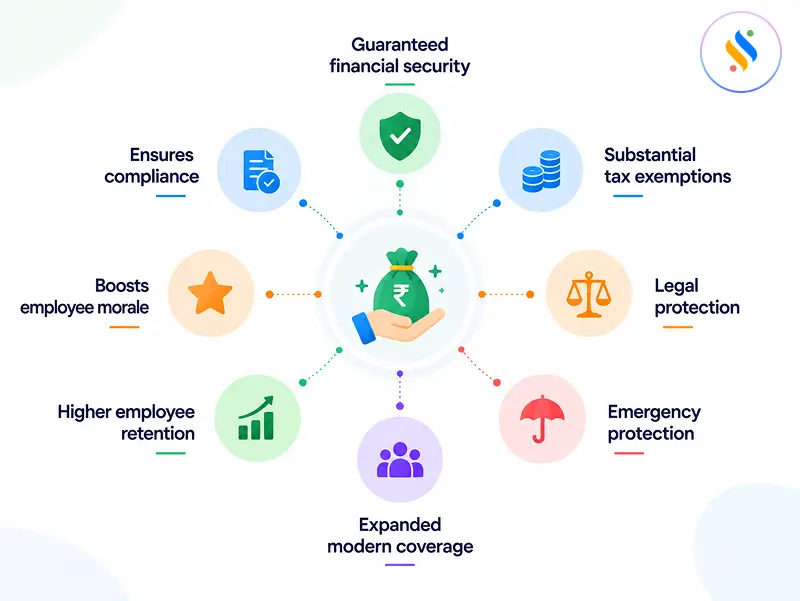
For employees,
1. Guaranteed financial security:
A lump sum on exit gives employees a financial cushion for the next phase of life – retirement, a career break, or unplanned changes without relying on personal savings alone.
2. Substantial tax exemptions:
Gratuity is tax-free up to ₹20 lakh under Section 10(10) of the Income Tax Act. This enables employees to keep more of the payout.
3. Legal protection:
Paying gratuity is a statutory right, and an employer can’t withhold it. Employees have the right to take the legal course if the gratuity is denied or delayed.
4. Emergency protection:
The death and disablement exceptions mean gratuity isn’t only a reward for long service. It also acts as a safety net for an employee’s family if something happens before the five-year mark is reached.
5. Expanded modern coverage:
Under the Code on Social Security, 2020, gratuity eligibility is being extended to fixed-term employees. This has widened the safety net beyond traditional permanent roles.
For employers,
1. Higher retention:
Because traditional eligibility requires a baseline of continuous service, when an employee receives a hefty gratuity payout incentivizes talent to stay longer, effectively increasing retention.
2. Boosts morale:
Rewarding an employee’s long-term association fosters an environment of mutual respect, driving up overall satisfaction.
3. Ensures compliance:
Adhering strictly to statutory gratuity ensures companies remain compliant, reducing the risk of legal disputes and non-compliance penalties.
Difference between gratuity and pension: Explained!
| Basis | Gratuity | Pension |
|---|
| Purpose | A lump-sum benefit paid to eligible employees for long-term service. | A regular income paid after retirement. |
| Payment type | Usually paid as a one-time lump sum. | Usually paid periodically, such as monthly. |
| Eligibility | Generally requires at least 5 years of continuous service, subject to statutory exceptions. | Depends on the applicable pension scheme and its eligibility rules. |
| When paid | Typically when employment ends due to retirement, resignation, termination, or other qualifying events. | Generally after retirement or on meeting the scheme’s conditions. |
| Calculation | Based primarily on last drawn wages and completed years of service under the applicable rules. | Depends on the pension scheme, contributions, service period, and applicable formula. |
| Governing framework | Payment of Gratuity Act, 1972, and applicable rules. | Depends on the relevant pension scheme, such as EPS or an employer-sponsored scheme. |
| Nature of benefit | A service-linked terminal benefit. | A retirement-income benefit. |
What kind of companies must pay gratuity in India?
The applicability of gratuity payment in India depends on the size of the organization, not the individual employee. Under the Gratuity Act, 1972, coverage extends to:
- Factories, mines, oilfields, plantations, ports, and railway companies.
- Shops and establishments employing 10 or more people in the past 12 months.
- Any other establishment notified by the central government.
An organization that falls under this stays covered under the Act even if headcount later drops below 10. Under the Code on Social Security, 2020, fixed-term employees also gain gratuity eligibility without waiting five years.
Note: Labour law provisions, including thresholds and notifications, vary by state and get updated from time to time. Always verify current applicability against your state labour department before making compliance decisions
Employee gratuity eligibility: The 5-year rule and its exceptions
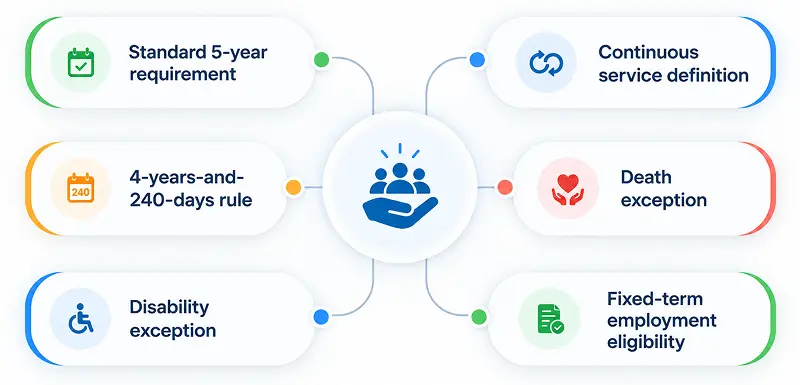
The 5-year rule
1. Standard requirement:
You must complete 5 full years of continuous service.
2. Definition of continuous service:
Approved leaves, maternity leave, medical absences, and strikes will not be treated as a break in service.
3. The 4-years-and-240-days rule:
An employee who completes 4 years and 240 days of continuous service is deemed to be eligible for gratuity.
Key exceptions:
1. Death:
If an employee passes away during his/her active service, the gratuity will be paid immediately to the nominee or legal heir.
2. Disability:
If an employee suffers an injury that disables him/her permanently, the service period requirement will be waived.
3. Fixed-term employment:
Under modern labour codes, fixed-term contract workers are eligible after completing even 1 year of service.
How is gratuity payment calculated?
The formula to calculate gratuity is:
Gratuity = (Last drawn salary × 15 × number of years of service) ÷ 26
Now, this is the general formula for gratuity calculation. However, the other formula is for organizations that don’t fall under the Act. Below it is:
Gratuity = (Last drawn salary × 15 × number of years of service) ÷ 30
“Last drawn salary” means basic pay + DA (Dearness Allowance). It excludes HRA, bonus, and other allowances. The 15 represents half a month’s wages for each completed year of service, and 26 is the number of working days considered in a month. Establishments not covered under the Act sometimes use a divisor of 30 instead.
Unlike PF, where a specific amount is deducted and visible in the payslip, there isn’t a single “gratuity deduction rate”. Instead, employers set aside an internal accrual, so the lump sum is funded.
But whether this provision appears within your CTC or stays entirely employer-side depends on company policy.
Note: Compliance figures, tax exemption limits, and the 15/26 formula are managed by the government and can be changed. Please verify current limits against the Ministry of Labour & Employment or a qualified tax advisor before any compliance decisions.
What does gratuity allowance mean in CTC?
Gratuity allowance in a CTC structure is an annual financial provision set aside by an employer to pay a lump-sum retirement or separation benefit, rather than an amount paid in your monthly take-home salary.
How does gratuity work in CTC?
1. Not paid monthly:
Even though gratuity is listed as part of your annual CTC, it isn’t added to your monthly payslip or in-hand salary. It stays a projected figure until you actually become eligible for the payout.
2. Not a salary deduction:
Unlike PF, gratuity isn’t deducted from your monthly pay. Employees don’t contribute anything toward it. The full amount is funded by the employer.
3. Accounting purpose:
The gratuity allowance exists mainly so the CTC reflects the employer’s total cost of employing you, including future liabilities. It lets the company account for the eventual payout in advance.
Step-by-step process to apply for your gratuity
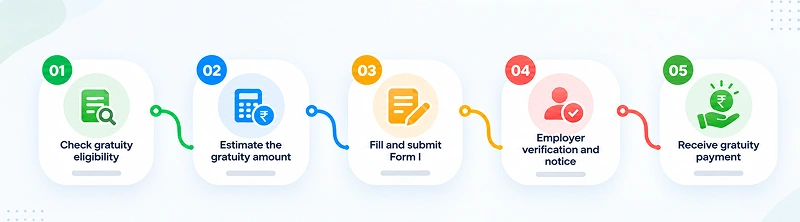
Step 1: Check eligibility:
Confirm with the employer and ensure that you’ve completed five years of continuous service. In case the employee has passed away or is facing disability of a permanent nature, the mandatory requirement of completing 5 years of service doesn’t apply.
Step 2: Estimate the amount:
Use the formula to get a rough figure. The formulas will help you calculate the right amount you will get from your employer.
Step 3: Fill out and submit Form I:
Complete Form I with your name, designation, department, and the date your service ended, and submit it to your employer ordinarily within 30 days of the gratuity becoming payable. A nominee uses Form F, and a legal heir uses Form J&K.
Step 4: Employer verification and notice:
Once your employer receives the claim, they verify your service records and last drawn salary, then issue Form L acknowledging the claim and confirming the amount payable.
Step 5: Receive payment:
The employer credits the gratuity amount to your registered bank account, typically within 30 days of the claim becoming due. If they delay beyond this window, simple interest becomes payable on the outstanding amount.
Gratuity policy in India: What employers must build into payroll
A compliant gratuity policy in India needs to account for who’s covered, how gratuity interacts with CTC, forfeiture rules for proven misconduct, and the 30-day payment deadline once a claim is filed. Employers who structure gratuity as part of CTC must be transparent about it in the offer letter and payslip, since it affects an employee’s real take-home pay versus their notional annual package.
Tracking this manually across employees with different joining dates is where most in-house payroll teams lose time. Payroll software with gratuity built into the salary structure can flag eligibility automatically the moment an employee crosses the five-year mark, instead of relying on HR to track anniversaries in a spreadsheet.
Conclusion
There you have it – a thorough, in-depth guide on gratuity payment in India. From understanding who is covered under the Act to checking and completing the claim process, gratuity payment involves several details that every HR needs to get right.
One of the biggest challenges that most HR face is keeping track of all the components of gratuity payment – service periods, salary components, eligibility, and calculations across the workforce.
And doing this manually can make the process tedious, time-consuming, and also increase the risk of errors.
This is where the right payroll system becomes the need of the hour. Super Payroll by Superworks helps HR manage employee data, salary structures, and payroll processes from one place, making it easier to keep gratuity-related calculations and records organized. Book a demo now!