What is Preboarding? Meaning, Process, Checklist & Strategies (2026)
What is Preboarding? Meaning, Process, Checklist & Strategies (2026)
Getting the offer letter signed is not the end of a hire. The candidate still has notice to serve at their current job, which usually means one to three more months before they sit at a desk in your office.
Preboarding is the name for everything your team does for that person until their first day. HR checks in once a week, shares a link for documents and gets the appointment letter signed online. IT keeps a laptop ready, and the reporting manager calls once to say hello. None of this takes much time, yet it is often the reason a candidate shows up on the joining date instead of switching to another offer.
The gap tends to be longer in India than elsewhere. Experienced employees commonly serve 30, 60 or 90 days of notice, and freshers hired from campus may join six months or more after getting the offer, so there is plenty of time for a candidate to drift away if nobody from your side stays in touch.
In this guide we explain what is preboarding, where it differs from employee onboarding, the 10 steps of a pre-onboarding process we recommend, a checklist you can download, seven strategies that work for Indian HR teams, and the features worth checking in preboarding software.
What is preboarding? Meaning and scope
Definition: Preboarding (you will also see pre-boarding or pre-onboarding) is the set of tasks that HR, IT and the reporting manager complete for a selected candidate while the candidate is still serving notice, so that the first day at work is spent on actual work rather than on filling forms.
If you came here searching for the pre onboarding meaning, it refers to the same stage. Different companies simply spell it differently, and on this page we have used preboarding throughout.
There is an easy way to check if your team is actually doing preboarding or just waiting for the joining date. Every task should have an owner and a due date.
Information should move in both directions, with HR sending the welcome note and letters and the candidate sending back ID proof and bank details. And the whole thing should end on joining day, because from that day onwards it becomes onboarding.
One common mistake is treating a single task as the whole of preboarding. A background check is only one part of it. Collecting copies of Aadhaar and PAN keeps you compliant, but it does nothing to keep the candidate interested in joining. The induction session on the first day, on the other hand, already belongs to onboarding.
Preboarding vs onboarding: the difference in one table
Preboarding is really the first stage of onboarding, and if you want to understand what happens after joining, our guide on what employee onboarding is explains the full journey.
| Comparison | Preboarding | Onboarding |
|---|---|---|
| Starts and ends | Offer signed to joining date | Joining date to around day 90 or confirmation |
| Main aim | Person joins, with laptop, logins and papers ready | Person learns the role and decides to stay |
| Who drives it | Recruiter and HR, plus the hiring manager | Hiring manager, with HR backing |
| Usual work | Welcome note, ID and bank proofs, letters, IT request, buddy, day-one plan | Induction, training, first assignment, weekly catch-ups, 90-day review |
| If you skip it | Signed offer, empty seat | Early resignations, slow start |
In simple terms, preboarding makes sure the person joins, and onboarding makes sure they stay.
Why preboarding cuts no-shows in Indian hiring
Ask any recruiter about their worst week and there is a good chance it involves a no-show. The offer got accepted, the requisition was finally closed and the backup candidates had already been turned down. Then the joining date arrived, the new desk stayed empty, and the phone kept ringing out.
In India, the notice period sets this up. Sixty or ninety days is a long window, long enough for a competing employer to put a bigger number on the table and for the current manager to come back with a counter-offer.
Strong profiles in IT, sales and finance rarely hold just one offer. Many keep two or three alive and make the final call in the last week. If your side has said nothing since the offer letter, that silence gets read as indifference, and the competing offer starts to feel like the safer call.
So when leadership asks whether preboarding is worth anyone’s time, answer with a number. Picture a 150-person SaaS company in Ahmedabad hiring a regional sales head at ?12 lakh CTC through a placement agency, and that person never turns up.
| Cost when one candidate does not join | Approx. amount |
|---|---|
| Placement fee, usually about one month’s CTC (8.33% of annual CTC), often paid again for the next hire | ?1,00,000 |
| Time of three interviewers across two rounds | ?25,000–?40,000 |
| Region without a sales head for two or three more months | Hard to count, usually the biggest loss |
| Direct cost per drop-out | About ?1.25–1.4 lakh, before lost sales |
These figures are only an example. The actual agency fee depends on your contract, and one month’s CTC is a common market practice rather than a fixed rule.
If this happens ten times in a year, the loss comes to roughly ?12–14 lakh, while a weekly email, a document upload link and an e-signed letter cost very little in comparison.
Beyond drop-outs, the experience itself matters. Gallup found that only 12% of employees strongly agree their organisation does a great job of onboarding, and that people with an exceptional onboarding experience are 2.6 times as likely to be extremely satisfied with their workplace (Gallup, 2021). For a new hire, that experience starts well before the first day.
Warning signs a candidate is wavering: replies that used to come within the hour now take a day, documents trickle in late, or a casual message asks whether joining could move “by a week or two”. Any one of these is your cue. Skip the next HR reminder and have the hiring manager pick up the phone that same day. Use the preboarding checklist below to see what is still pending.
The pre-onboarding process, step by step (offer to day 0)
Treat the process below as a template. For someone joining in 15 days, squeeze it into two weeks; for a campus hire joining next July, spread it out month by month.
| Step | When | What to do | Owner |
|---|---|---|---|
| 1. Confirm and welcome | Within 2 days of the yes | Log the yes, then mail the candidate their joining date, a single point of contact and the next few steps | Recruiter |
| 2. Collect documents online | Week 1 | HR shares one upload link for ID, bank, education and previous-job papers, then verifies each file | HR |
| 3. Send letters for e-sign | Weeks 1–2 | Appointment letter and any NDA go out for digital signature, with EPF Form 11, Form 2, gratuity Form F and, where it applies, the ESIC declaration | HR |
| 4. Start background checks | Weeks 1–2 | Check degrees, earlier employers and current address; make one reference call | HR or vendor |
| 5. Raise IT and admin requests | Weeks 2–3 | Ticket to IT and admin for the machine, mailbox, licences, access card and a desk | IT and Admin |
| 6. Introduce the team | Weeks 2–3 | Manager rings the candidate for 15 minutes; a buddy is named; the team hears about the new joiner | Manager |
| 7. Share the plan | Weeks 3–4 | A one-page note with the first week’s calendar and goals for month one | Manager and HR |
| 8. Send day-one details | 7 days before | Time to report, office address, dress code, originals to bring and the name to give at reception | HR |
| 9. Check readiness | 2 days before | Machine configured, logins tested, employee added to payroll ahead of the cut-off | IT, HR, Payroll |
| 10. Hand over | Day 0 | Candidate profile is converted into an employee profile | HR |
Two things Indian HR teams often miss here:
- Payroll cut-off. If an employee joins on the 28th and your payroll closes on the 25th, their first salary will be delayed unless their record has already been created. See the complete list of onboarding documents required in India.
- PF and ESIC. Collect the UAN (the employee’s permanent PF number) in the first week, and check ESIC eligibility before the first payroll run. At present ESIC applies when gross pay is ?21,000 a month or less.
Preboarding checklist (free download)
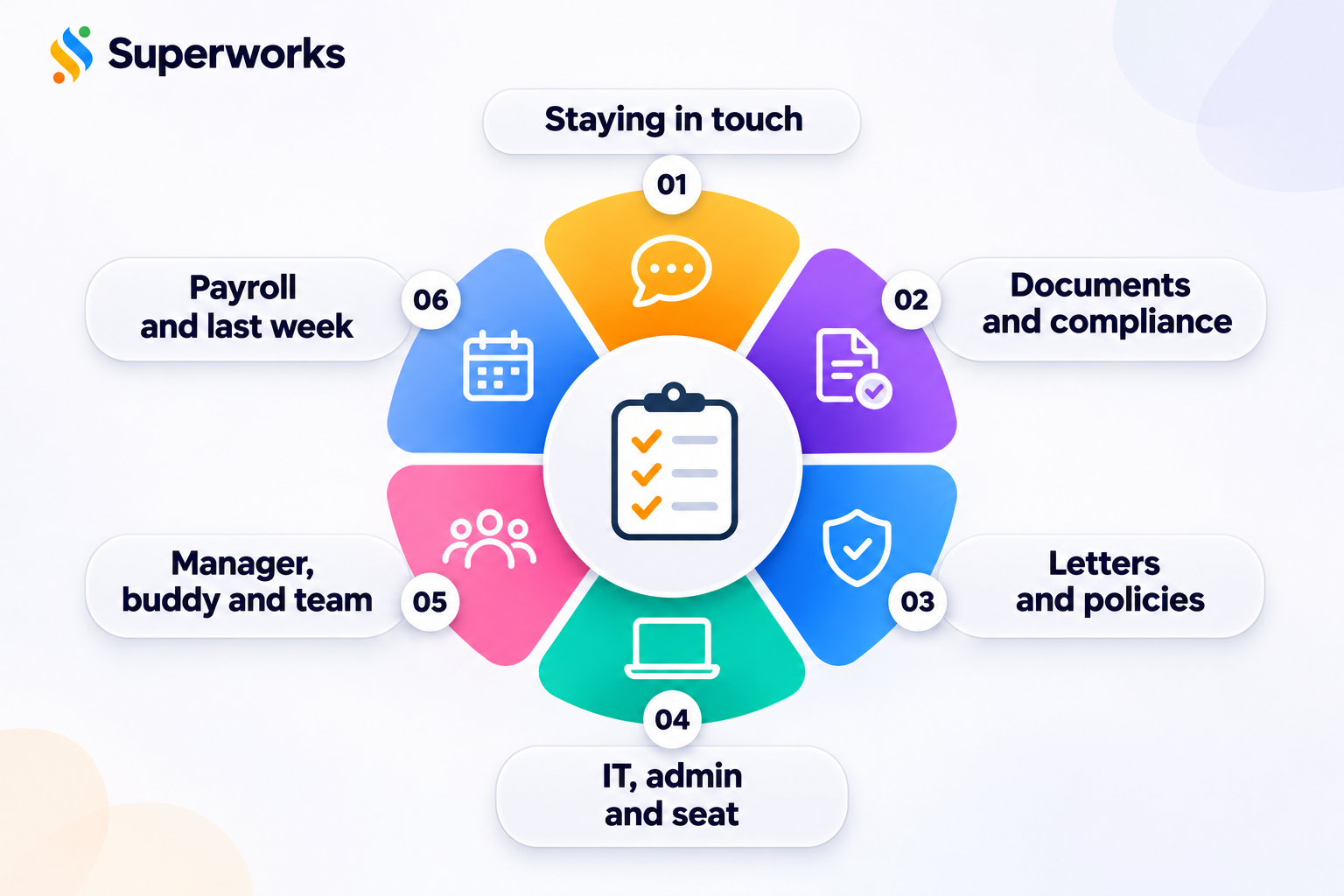
We suggest running through this preboarding checklist for every new joiner. It is also available to download as an Excel sheet and a PDF.
Staying in touch
- Yes from the candidate logged, with the date they plan to join
- First hello mail gone out inside 48 hours
- A weekly touchpoint on the calendar till day one
- At least one call between the reporting manager and the candidate
Documents and compliance
- Aadhaar, PAN, photos and a cancelled cheque or passbook copy in, and checked
- Degree or mark sheets, last company’s relieving and experience letters, latest payslips in hand
- PF Form 11 and Form 2 plus gratuity nomination (Form F) filled; ESIC declaration too if gross pay is ?21,000 or below
- Verification vendor briefed; report on file before joining
Letters and policies
- Appointment letter signed online (plus NDA, where your company uses one)
- Code of conduct, leave, IT use and POSH policies sent for reading
IT, admin and seat
- IT ticket raised for laptop, email ID and software licences, due two days before joining
- ID card printed, access card active, desk allotted, logins tested once
Manager, buddy and team
- Buddy picked and introduced; team told who is coming and when
- First-week calendar and one-month goals put on paper
Payroll and last week
- Payroll record created before the monthly cut-off; old or new tax regime choice and investment declaration (Form 124, earlier Form 12BB) collected
- Joining-day instructions mailed a week ahead
- Final readiness check by IT and HR on the eve of joining
Stop losing signed offers to silence.
Superworks Recruit collects documents, routes the offer for approval and gets it e-signed in one candidate portal, so no joiner goes quiet on your watch.

7 preboarding strategies and activities that work
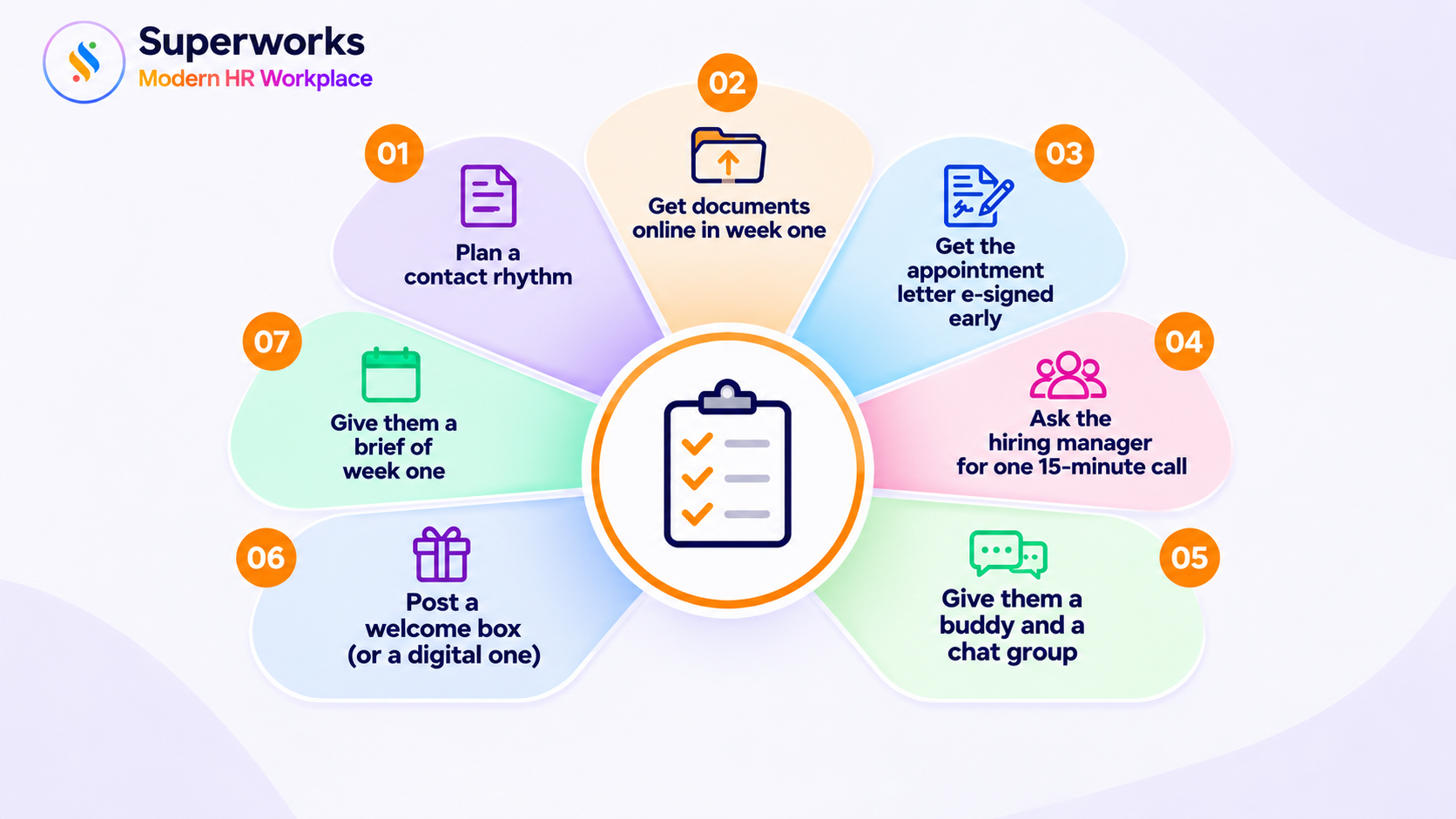
Most of the preboarding strategies for HR that work well need someone to own them and a calendar to follow, not a big budget. The seven below are suited to Indian companies with roughly 20 to 500 employees.
1. Plan a contact rhythm
Send one message every week until the joining date, and try to have it come from the same person each time. In the first week, share the welcome and next steps. In the second, send a reminder about documents along with a short note about the team. The third week is a good time for the manager’s call, and in the fourth you can share the plan for the first week.
2. Get documents online in week one
Rather than sending ten emails asking for ten different documents, send a single upload link. A portal with a list of required documents and automatic reminders shows you what is still pending, and the speed at which a candidate uploads also tells you something about how serious they are. If nothing has come in after two reminders, it is time to call them.
3. Get the appointment letter e-signed early
While a candidate is serving notice, a signed appointment letter is one of the clearest signs that they intend to join. Send it as soon as verification is complete and let them sign it on their phone. If you need a template, you can start with our joining letter format.
4. Ask the hiring manager for one 15-minute call
In this call, the hiring manager explains what the first month will look like and who the new hire will be working with. Candidates tend to remember this conversation much more than any email from HR, so it is worth scheduling it for the second week.
5. Give them a buddy and a chat group
Choose a peer to act as a buddy before the joining date, and add the new hire to a small welcome group on chat a few days before they start, so that they already know a couple of names when they walk in.
6. Post a welcome box (or a digital one)
Nothing says “we are expecting you” quite like a parcel at the door. A box with a company mug, a diary and a handwritten note from the team typically runs ?800 to ?2,000 a head, which is money well spent on senior joiners and people who will work from home. On a zero budget, put together a digital version instead: a welcome letter, a few photos of the team and a one-minute video from the founder.
7. Give them a brief of week one
Around three days before the start date, email a simple day-by-day outline of the first week. Mention the people they will be introduced to, the tools they will be trained on and one small piece of work they can wrap up by Friday, plus a sentence on what success in month one means for their job. A joiner who already knows how Monday will go has far less reason to keep a backup offer warm.
Quick preboarding activities for this month (also known as preonboarding activities): ask the manager to record a short hello on their phone, include the new person in a team lunch just before they join, and send remote joiners a casual video tour of the office.
Preboarding for remote and campus hires
Two kinds of joiners need extra thought: people working remotely and freshers coming straight from campus.
Remote joiners might never set foot in the office. Ship the laptop and the welcome box so they land two days ahead of the start date, run a quick call the evening before to check VPN access and logins, and do the manager chat and buddy introduction on video. Make a note of the state they will work from too, since professional tax and Labour Welfare Fund rules depend on it.
Campus hires can be waiting six to ten months between offer and joining. Keep the connection alive with a short online learning path, a virtual meet-up every six to eight weeks and a hello video from their future team, then call them 30 days before the date to confirm they are still on track.
Ready-to-use preboarding messages
Knowing you should stay in touch is easy; knowing what to write is harder. The three short drafts below cover the moments that matter most. Swap in your own names and dates, and tweak the wording until it sounds like your company.
Welcome email (within two days of acceptance)
Subject: Welcome to [Company], [Name]
Hi [Name], we are really glad you said yes. Your joining date is [date], and I will be your contact until then, so write to me or call me on [number] for anything at all. Over the next week you will get a link to upload your documents, which takes about 15 minutes. Your manager, [Manager name], will also call you in the next two weeks to talk about your first month. See you soon, [Your name], HR
WhatsApp check-in (weeks 2 to 4)
Hi [Name], hope the handover at your current job is going fine. Just a reminder that your PAN and bank proof are still pending on the portal. Also, [Manager name] wanted to set up a short call this week. Does Thursday evening work for you?
Joining-day details (7 days before)
Hi [Name], one week to go. Please report at [time] on [date] at [office address] and ask for [contact name] at reception. Carry your original ID and education certificates for verification. The dress code is [dress code], and your laptop and email will be ready when you arrive.
Common preboarding mistakes to avoid
These are the gaps that most often lead to a joiner backing out or having a rough first week:
- Going quiet after the offer. Even one message a week is better than 60 days of silence.
- Chasing documents over email. Ten separate requests irritate candidates; one upload link does not.
- Keeping the manager out of it. Candidates want to hear from the person they will report to, not only from HR.
- Creating the payroll record after joining. The first salary gets delayed, and that is a poor start.
- Treating campus hires like experienced hires. Six months without contact is a long time for a fresher with other options.
Preboarding software: what to look for
What is preboarding software? In most cases it is a module within an applicant tracking system or an HRMS, and some vendors also call it preonboarding software or a candidate portal.
If you hire up to about five people a month, a spreadsheet and email can usually manage, but beyond that HR spends more time chasing documents than the tool would cost. These are the features worth checking:
| Feature | Why you need it |
|---|---|
| Candidate portal with a list of required documents | Joiners upload in one place and HR sees gaps without follow-up calls |
| Approve or reject each document, with a reason | Unreadable copies are sent back and fixed before joining |
| Letter templates with approval and built-in e-sign | Every letter looks the same, gets sign-off before release and needs no printer |
| PF, ESIC, PT, TDS and LWF details captured | Salary, PF and tax are correct from the first payslip |
| Hand-over to HRMS without typing again | The employee master is built from verified details, not retyped |
| Activity log and role-based access | You know who did what; candidate data is covered by the Digital Personal Data Protection Act, 2023 |
For setup details and pricing, see our page on preboarding software.
How Superworks handles preboarding
Superworks Recruit, our applicant tracking system, handles preboarding in six steps: Kick-off ? Information Gathering ? Verify Information ? Release Offer ? Offer Acceptance ? Hired. Each step has its own tab showing how many candidates are in it, which lets a recruiter quickly see where people are getting stuck.
- Start and portal: the recruiter adds selected candidates to preboarding individually or in bulk, and decides whether documents should be verified before the offer or after it is released. The candidate then receives a “Pre-Boarding Signup” email, creates a login and uploads their basic details, family details and documents, and the recruiter can send reminders if anything is missing.
- Verification: the recruiter approves or rejects each document with a reason, either one by one or in bulk, and the candidate is informed of the result. Pending documents can also be approved automatically after a set number of days, and PF, ESIC, PT, TDS and LWF details are captured for payroll.
- Offer and approval: the offer letter is generated from your company’s own template, with placeholders that fill in the candidate, job and salary details. If your process requires it, the letter can go through a multi-level approval before it is released.
- E-sign: the offer is sent by email, and on WhatsApp as well if that add-on has been switched on. The candidate and the company signatories sign it within Superworks using a drawn, typed or uploaded signature, and everyone receives a copy of the signed PDF, without the need for an outside e-sign tool.
- Accept or decline: from the portal, the candidate can accept the offer and share an expected joining date, or decline it with a reason. The recruiter also has the option to cancel the offer or send a revised one.
- Move to Onboarding: with one click, the HRMS Add Employee form opens with the personal details, job, salary, statutory flags, verified ID documents and signed offer letter already filled in. This hand-over requires the HRMS software from Superworks. From that point, the employee onboarding workflow, with its welcome kit, task checklist and policy acknowledgement, takes over.
Next step
So, to sum up what is preboarding: it is the work that turns a signed offer into a person who actually joins. A good way to start is to pick your next three hires, run the 10 steps above with one owner for each step, and compare your offer-to-join ratio after a quarter. You may also find our employee onboarding process guide useful, along with our list of onboarding documents.
Table Of Content
Recent Things
- What is Employee Onboarding? Meaning, Objectives, Stages & Process
- A Simple & Effective Guide to the Employee Onboarding Process
- The Benefits of HCM Your Top Management Actually Wants to See!
- Still Using Spreadsheets? It’s Time to Switch to HCM Software!
- A Guide for Indian SMBs on the Human Capital Management System
FAQs
What is preboarding?
Preboarding refers to everything HR, IT and the hiring manager do between the day a candidate signs the offer and their joining date. This includes staying in regular contact, collecting documents, getting the appointment letter signed online, setting up the laptop and logins, and introducing the manager and team, so that the person joins on the agreed date and is ready to work.
What is the pre-onboarding process?
The pre-onboarding process and the preboarding process are the same thing. In our approach it has 10 steps: a welcome, document collection, e-signed letters, a background check, IT and admin requests, introductions, a plan for the first week, joining-day details, a readiness check and, finally, the hand-over to onboarding.
What is the difference between preboarding and onboarding?
The joining date is the dividing line. Preboarding covers the period before it and focuses on making sure the person joins and is set up, while onboarding starts on the joining date and usually runs for around 90 days, with the aim of helping the person become productive and stay. In that sense, preboarding is the first stage of onboarding.
What are preboarding activities?
Common preboarding activities include welcome emails and calls, a call with the manager, assigning a buddy, sending a welcome kit, adding the person to a team chat, sharing a first-week plan, a short pre-read or product video, and a mail with joining-day details. Document collection and letter signing are part of preboarding too, although on their own they do little to keep a candidate engaged.
What is a pre-boarding engagement strategy?
A pre-boarding engagement strategy is a plan that sets out who will contact the candidate between the offer and joining, how often, and what they will share, for example the welcome mail, the manager's call, a buddy chat and the first-week plan. Its main purpose is to keep the person committed until their joining date.
How do you measure preboarding success?
We recommend tracking three numbers every quarter: the offer-to-join ratio (joiners divided by accepted offers), the percentage of joiners whose documents and letters were complete before day one, and day-one readiness, which means the laptop, logins and payroll record were ready on time. An offer-to-join ratio above 90% is a good target.
How long does preboarding last?
Preboarding usually lasts as long as the notice period. In India this is typically 30 to 90 days for experienced hires and 15 days or less for immediate joiners, while campus hires who receive offers before graduating may be in preboarding for six to ten months.

