What is Employee Onboarding? Meaning, Objectives, Stages & Process
Employee onboarding is everything a company does to help a new hire find their feet, from the day they accept the offer until they can do the job confidently without hand-holding. Yes, there’s paperwork. But tools, training and the people they’ll work with matter just as much.
Ask an HR manager at a typical Indian SME about employee onboarding and you’ll usually hear a list of joining-day jobs. Copies of Aadhaar and PAN. A signed appointment letter. A laptop. Honestly, that lot gets wrapped up before lunch on day one. Proper onboarding? That runs a month, two, often three. And somewhere in those weeks your new joiner makes up their mind: stick around, or start answering the recruiter who keeps pinging them on LinkedIn.
Below, we’ve put down what we’d want a new HR exec to know about it. What the word really covers, what it’s meant to achieve, the five stages, who does which bit, a few numbers worth watching, plus the stack of Indian joining documents nobody enjoys chasing.
What is employee onboarding? A quick definition
You welcome a new person, finish their joining paperwork, give them the kit, know-how and contacts the job needs, and stay in their corner until they’re managing fine without you. Planned, not ad hoc.
In other words, the employee onboarding meaning is much bigger than “formalities”. Here’s what makes the difference:
- It starts before day one. The weeks between the offer and the joining date (preboarding) count too.
- It runs on a plan. Every task has a name and a date next to it. “HR will see to it” isn’t a plan.
- It has an end point. Give it roughly three months and, if things went right, the person is pulling their weight and no longer feels like the new kid.
Onboarding vs induction vs orientation vs preboarding
These four words get used interchangeably in a lot of HR teams we talk to. Close cousins, sure. Same thing? No.
| Term | What it covers | Typical length | Led by |
|---|---|---|---|
| Preboarding | The stretch from offer acceptance to joining day: paperwork, a welcome email, IT requests, a day-one schedule | 1–4 weeks before the start date | HR with the recruiter |
| Orientation | A single first-day session on the company, key policies, ID card and logins | Half a day to 2 days | HR |
| Induction | Getting to know the department, the role, colleagues and the daily work | Weeks 1–2 | Reporting manager |
| Onboarding | The complete journey, combining preboarding, orientation, induction and the 30-60-90 day ramp-up | 30–90 days, sometimes up to 6 months | HR, manager and team together |
Employee orientation vs onboarding: the simple rule
A handy way to keep them apart? Orientation happens once. Onboarding keeps going. Orientation and induction both happen inside onboarding, so a great day-one session is a decent start and nothing more.
Why onboarding matters: the numbers
One caveat up front. Almost all the onboarding research out there is from the US; good large-scale Indian data is hard to find. That said, if you’ve ever had a new joiner go silent halfway through their notice period, none of this will surprise you.
- Gallup‘s numbers are pretty blunt: only 12% of employees strongly agree that new people are onboarded well where they work. That leaves plenty of room to stand out.
- Click Boarding data published by SHRM in 2017 found that people who had a great onboarding experience were 69% more likely to stay for three years.
- The same SHRM piece says nearly one in three new hires quits within six months.
- And in Insight Global’s 2025 Employee Sentiment Report, workers said it takes them 6 to 7 months, on average, to feel settled in a new role (survey of 905 US workers).
What a failed onboarding costs: an Indian example
Want a rupee number? Here’s a made-up but realistic one. A 120-person IT services firm in Pune takes on a developer at ₹6 lakh CTC, so roughly ₹50,000 a month. No laptop on day one, no real plan, a manager who’s always “in a call”, and by month three there’s a resignation mail sitting in HR’s inbox. The damage looks something like this:
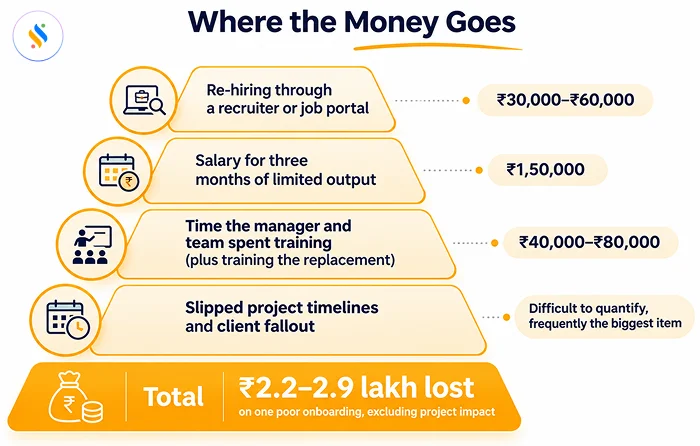
There’s another cost that’s very Indian: the offer drop-out. A candidate accepts, starts a 30- to 90-day notice period, hears nothing from you for weeks, and joins someone else. A short message every week during that period is the cheapest insurance you can buy.
The 5 stages of employee onboarding
Here’s the backbone of a solid onboarding process in HRM: five stages, each with its own job.
| Stage | Timing | Key activities | What success looks like |
|---|---|---|---|
| 1. Preboarding | From offer acceptance to the joining date | Send a welcome email, gather and check documents, run background verification, raise laptop and ID requests, name a buddy, finalise the first-week schedule | The candidate stays engaged and turns up |
| 2. Day one (orientation) | The first day | Sign paperwork, switch on system access, introduce the company and its policies, collect acknowledgements, meet the team over lunch | The person feels they were expected |
| 3. First week (induction) | Days 2 to 7 | Walk through the role and goals, demo products and processes, meet key colleagues, hand over a first small task | They understand the work and the people |
| 4. First 30–60 days | Weeks 2 to 8 | Structured training, a check-in every week, first real outputs, feedback in both directions | They contribute with support |
| 5. 60–90 days and beyond | Until day 90 or the end of probation | Performance review, probation decision, career conversation, onboarding feedback survey | They work independently and choose to stay |
Most Indian companies skip stage 1, and that’s exactly where they lose people before day one. We’ve covered it in detail here: what is preboarding?
Stop losing new hires before day one
Stop losing new hires before day one. Super HRMS sends a Welcome Kit the moment the offer is accepted, so candidates fill in their own details and documents while HR tracks every task on one board.

30, 60, 90: what good looks like
- Day 30 — job, tools, team, house rules: sorted. One actual task done and dusted.
- Day 60 — the everyday stuff gets handled with only the odd nudge, and they’ve got people they can go to.
- Day 90 — working solo, owning their numbers, and with some idea of where they go from here.
Onboarding goals and objectives: what HR should aim for
Ask a founder what onboarding is for and you’ll probably hear “getting the paperwork done”. That’s one goal out of seven. Miss any of the onboarding goals and objectives below and, frankly, the job’s only half done.
- Compliance. Papers in, PF/ESIC/nomination forms filed, policies signed off. The boring bit, but it has to be watertight.
- Role clarity. Try this around week two: ask them what’s due from them this month and how their boss will rate it. If you get a shrug, that’s your first fix.
- Faster time to productivity. Full output in weeks, not months.
- Belonging. They know the team, they have a buddy, and they don’t feel silly asking questions.
- Culture. They pick up “how we do things here” from watching people, not from a poster in the pantry.
- Retention. They decide to stay. Most people make that call in the first 90 days, whether they say so or not.
- Employer brand. New joiners talk, to their friends and on Glassdoor and AmbitionBox.
The 4 C’s of onboarding
If you like frameworks, Dr Talya Bauer’s work for the SHRM Foundation boils all of this down to four building blocks: Compliance, Clarification, Culture and Connection (Bauer, Onboarding New Employees: Maximizing Success, 2010).
Compliance is the base level, and most companies handle it fine. The other three are where good onboarding really shows. Add a fifth: Confidence, the new hire’s belief that they can actually do the job.
Who does what: HR, manager, IT and buddy
“Everyone’s responsible” usually ends with nobody doing it. Put names against tasks. On paper.
| Owner | Before the start date | On day one | Through day 90 |
|---|---|---|---|
| HR | Send the welcome email, collect documents, run the background check, issue offer and appointment letters, have policies ready | Complete paperwork, lead orientation, record policy acknowledgements, issue the ID card, file statutory forms | Track probation, hold 30/60/90 check-ins, run the feedback survey |
| Manager | Draft the role plan and first-week tasks, tell the team who is joining | Discuss the role, introduce the team, assign a first task | Weekly one-to-ones, training plan, 90-day review, probation call |
| IT / Admin | Arrange laptop, email ID, software licences, access card and desk | Hand over equipment and test every login | Adjust access as responsibilities grow |
| Buddy | Send one friendly hello | Lunch together, an office walk-around, the unwritten rules explained | Answer questions daily in week one, meet for coffee weekly for a month |
| Finance / Payroll | Capture the salary structure and bank details | Add the employee to payroll ahead of the cut-off | Pay the first salary on time with an accurate payslip |
| New hire | Upload documents, go through the welcome kit | Sign, ask questions, meet people | Finish training, share feedback |
Out of everything in that grid, one line matters most to a new joiner, and it’s money: salary on the right date, with the right numbers. Loop payroll in while the person’s still serving notice; waiting until they’ve joined is how first-month salaries go wrong.
Documents and compliance steps in India
In India, the paperwork falls into four groups. (For the full list with templates, see our guide to onboarding documents required in India.)
| Group | Documents to gather |
|---|---|
| Identity and address | Aadhaar; PAN (required for TDS on salary); passport-size photos; a separate address proof if the person no longer lives at the Aadhaar address |
| Employment | Signed offer and appointment letters (joining letter format); relieving and experience letters from the last employer; the three most recent payslips; the previous employer’s salary TDS certificate (Form 16, replaced by Form 130 under the Income-tax Rules, 2026); education certificates; an NDA where relevant; signed policies (code of conduct, leave, IT, POSH) |
| Statutory forms | EPF Form 11 (composite declaration) with the earlier UAN; EPF Form 2 (nomination for PF and EPS); ESIC declaration where gross monthly wages do not exceed ₹21,000; Form F (gratuity nomination); Form 124, which replaced Form 12BB (claims for deductions and exemptions for TDS), submitted on joining and again at the start of every financial year |
| Bank and personal | A cancelled cheque or passbook copy for salary payments; emergency contacts and family details; a medical fitness certificate when the job calls for one |
Three compliance notes:
Data protection. Yes, the DPDP Act, 2023 applies to your employees’ data as well. Does the job really need their blood group or their father’s PAN? If not, skip it. What you do hold should sit somewhere secure, be visible to as few people as possible, and the joiner should hear from you what’s being collected and what for.
Verification. Where you’ve got the option, run Aadhaar and PAN through a government check. Doctored documents turn up more often than you’d guess.
Form names. Fair warning, a few of these forms got renumbered when the labour codes and the Income-tax Act, 2025 came in, and it may not be the last round. Ring your CA once before the checklist goes to print.
Your employee onboarding checklist (free download)
We’d call this the minimum. Every joiner, no exceptions. Tired of ticking it off in Excel? Plenty of teams move the same list into employee onboarding software.
- Welcome email out within 48 hours of the offer being accepted
- All documents received and checked before the joining date
- Background and reference checks closed
- Laptop, email ID, tool access and desk ready for the first day
- Buddy named and introduced
- Day-one details (time, venue, point of contact) sent to the candidate
- Appointment letter signed and policies acknowledged
- PF, ESIC and nomination forms done
- Employee on payroll before the cut-off
- Manager’s first-week induction plan ready
- Day 30, 60 and 90 check-ins booked
- Probation review held and feedback survey completed
Download: Employee Onboarding Checklist – India (Excel and PDF). For the extended version, see our onboarding checklist.
Common onboarding mistakes (and the fix for each)
| Mistake | How it shows up | What to do instead |
|---|---|---|
| Going quiet after the offer | 45 days with no contact, and the candidate accepts a rival offer | Touch base every week of the notice period |
| A chaotic first day | No laptop or email, and the manager is stuck in meetings | IT and the manager share a day-one checklist and review it 48 hours ahead |
| “Here’s the policy folder” | A 40-page PDF handed over without context | A 30-minute walkthrough of the five policies used every day |
| Nothing to do early on | Two weeks of shadowing with no output | A small but real deliverable within week one |
| No feedback until probation | The first proper conversation happens at the probation review | A 20-minute check-in each week during month one |
| Onboarding ends after orientation | Nothing is planned beyond day one | A written 30-60-90 plan for every role |
How to measure onboarding: 5 numbers to track
Once a quarter, pull these five. Most of them are sitting in your HRMS already. And a disclaimer: the targets in the third column are what we at Superworks suggest you start with. They’re not some industry standard.
| Metric | Formula | Suggested target |
|---|---|---|
| Offer-to-join rate | Number of joiners ÷ accepted offers | Over 90% |
| Day-one readiness | Joiners whose laptop, email and desk were ready ÷ total joiners | 100% |
| 90-day retention | Joiners still on the rolls at day 90 ÷ total joiners | Over 95% |
| Time to productivity | Days until the manager marks the person as “working independently” | 60–90 days for most roles |
| Onboarding satisfaction | Mean score from the day-30 feedback survey (1–5 scale) | 4 or higher |
Formulas, plus a handful of extra metrics, are in our guide to onboarding metrics.
How does Superworks handle onboarding?
Here’s how it plays out in Superworks. Onboarding is a pre-joining workflow that walks a new hire from “offer accepted” to “first day”, and nobody in HR ends up re-typing what the candidate already filled in. Because it’s built into the HRMS software, there’s no export-import dance at the end: HR converts the candidate and the employee onboarding record becomes their employee record, done.
- Onboarding Fields template. Which details should the candidate type in themselves? HR ticks them: personal info, address, documents, bank details, UAN, family, emergency contact, education, past jobs. Each one can be must-fill, optional or off.
- Welcome Kit. A welcome letter, some company background, where to show up on day one, and any files you want to tack on. The candidate fills their form on a self-service page. Gone quiet? HR hits remind.
- Task checklist. You build an Onboarding Template once. Each task gets an owner, followers, a due day, attachments. Then the Onboarding Employees board shows, for every candidate, how many tasks are done out of the total and when they’re joining, and it can mail the team a set number of days before that date.
- Add as Employee. Once a candidate hits Completed, HR clicks “Add as Employee”. If your company wants new hires approved first, it raises an approval request instead.
- E-signed letters and ID checks. Offer and appointment letters are built from templates and signed online, and there’s an audit trail of who signed what. Aadhaar and PAN verification against the government database is there too, on plans that include it.
- Policy acknowledgement. Mark a policy as must-read and it greets the employee at first login; no accepting, no moving on. Sounds fussy until an auditor, or a disciplinary hearing, asks you to prove they agreed.
- After day one. The new person shows up in Superworks Payroll on their own, can start induction courses in Superworks LMS straight away, and lands on the probation list, where HR confirms, extends or ends it.
Using Super Recruit as well? Then preboarding happens over there. Documents get collected and checked, the offer letter gets e-signed, and one click on “Move to Onboarding” opens the HRMS Add Employee form with the candidate’s details already in it.
Next step
So, what is employee onboarding, if we had to boil it down? About three months of steady, planned effort. A hectic joining day isn’t it. Does your process today end with a day-one checklist? Don’t rip it all up. Just try two things this month. One: a welcome email during preboarding that lets the candidate upload documents online. Two: twenty minutes a week with each new joiner, for their first month. Once those stick, our step-by-step employee onboarding process and the 15 onboarding best practices Indian companies use are good next reads.
Want the welcome kit, task checklist, e-signed letters and policy acknowledgements in one place? Book a 20-minute Superworks demo.
Table Of Content
Recent Things
FAQs
What is employee onboarding in simple words?
If a friend who's never worked in HR asked us, we'd say: employee onboarding is everything you do so a new person doesn't feel lost. Their papers get sorted, their laptop works, somebody shows them around and introduces them, and someone keeps an eye on them for the first couple of months, until they've found their feet. Thirty to ninety days is normal.
What is the difference between onboarding and induction?
People use them as if they're the same, and in a lot of offices nobody minds. Strictly, though, induction is the manager's part, the week or two where the new hire gets walked through the team, the department and their own role. Onboarding starts earlier (the day the offer's accepted) and ends later (when they're fully productive), so induction sits inside it.
What is the difference between orientation and onboarding?
Orientation is the joining-day session, the one with the company slides, policy talk, ID card and logins. It happens once. Onboarding is the whole 30 to 90 day journey around it.
What is onboarding in HRM?
In HR textbooks it's the stage of the employee life cycle that follows recruitment. A neat way to remember what it should cover is the 4 C's: compliance, which is your documents and statutory forms; clarification of what the job expects; culture; and connection, meaning the colleagues they'll actually lean on.
What are the main objectives of onboarding?
We'd list seven, roughly in the order companies tend to think of them: staying compliant, making the role clear, getting people productive faster, helping them feel they belong, passing on how the place works, keeping them through those wobbly first months, and giving them a good story to tell about you later.
What are the stages of onboarding?
Five, the way we've laid them out above. Preboarding before joining, orientation on day one, induction across the first week, a training-and-check-ins phase up to about day 60, and finally a review between day 60 and 90 that usually ends with the probation call.
What are the 4 C's of onboarding?
Compliance, Clarification, Culture and Connection. The framework comes from Dr Talya Bauer's guide for the SHRM Foundation, and you'll see a few HR software companies add Confidence as a fifth C.
How long should employee onboarding take?
Give it at least ninety days. The formalities are over on day one, of course, but most people need two or three months before they're at full pace. That's why plenty of Indian companies just let onboarding run for the length of probation, often three to six months.
Is onboarding different for factory, retail or field staff?
Not in its stages, but very much in how it's run. Picture a picker joining a Bhiwandi warehouse: no desk, no laptop, maybe no company email at all. The document form has to open on their phone, and the welcome note should be in Hindi or Marathi, whichever they're comfortable reading. Safety training happens before they touch a forklift, so day one. ESIC registration applies too if gross pay is ₹21,000 a month or less. And the weekly check-in is the shift supervisor's job, because HR is rarely on that floor.
How do you onboard remote or hybrid employees?
Pretty much the same way, with the logistics moved online. Courier the laptop early enough that it's there before day one, handle documents and signatures digitally, do orientation on a video call, and block a daily slot for the buddy to check in during that first week.

