
TL; DR
Also known as a payslip, a salary slip is the official monthly record of what an employee earns and how much of it gets deducted. Once all this is done, only the money goes into an employee’s bank account. It typically includes earnings, deductions, and net pay. One of the biggest reasons why salary slips are generated is because it serves as proof of income when applying for loans and visas. For employers, it is mandatory to generate salary slips at the time of their payroll cycles. With the changing times, most businesses have chosen an alternative way. They have payroll solution that enables employees to view/download the salary slip on their own without the need for HR. Through this blog, you will learn about salary slips.
Imagine you go to a bank to apply for a home loan. As part of the process, the bank’s loan officer asks you about your CTC, your HRA, etc., and you give him a number. But what if he asks you to prove it? Can you? Chances are that you won’t be able to do that because it is only possible if you have a salary slip.
This is one of the most important documents that is either not normally provided to employees or that employees don’t pay too much attention to. The reason why a salary slip is important is that it is proof that you’re employed, you’re earning, how much deductions are happening, and how much you are overall getting.
In this guide, we’ll break down what a salary slip is, why it matters, every component you’ll find on one, how to read and download your payslip online, and everything in between.
What is a salary slip?
An important document as part of payroll processing, a salary slip is a formal record that an employer, on behalf of their organisation, issues to their employees. It contains a complete breakdown of an employee’s salary for a month. A salary slip typically includes:
- Company details (name, address, etc.)
- Employee details (name, employee ID, department, title, bank name, A/C number, UAN number, PAN, etc.)
- Pay period, total working days, and leave taken
- Earnings
- Deductions
- Net pay in numbers and words
Under Indian labour law, issuing a payslip each pay cycle is mandatory, and employers who skip it can run into compliance trouble during auditing.
Usually, employers issue a salary slip either as a printed copy or it gets emailed as a PDF. However, in the past few years, with the increase in the adoption of HR and payroll software, employees are able to view/download salary slips on their own, thanks to the software’s self-service portal feature. This saves a great deal of time not only for employees, but for HR too.
Plus, the benefit here is that all the employees’ data – attendance, leave, shifts, reimbursements, and expenses flows straight from the HR platform to the payroll platform. And on top of that, it’s easy to generate salary slips through payroll platforms. This way, there will be no need to create them manually.
5 reasons why you should not ignore a salary slip
If any employer thinks that presenting employees with a salary slip is a formality, then it’s a mistake. For employees, it’s a document that they need when they apply for loans, IT filings, etc.
1. Detecting payroll and allowance errors:
A salary slip is the quickest way to catch a payroll error. Manual data entry or a missed attendance update can throw off your HRA, DA, or bonus calculation if no one checks. Reviewing payslips helps you spot these mismatches early.
2. Verifying deductions:
Every deduction on your salary slip should match what you actually owe. Salary slips let you cross-check these figures against your own calculations, so you’re not silently overpaying tax or contributing an incorrect PF amount month after month without realizing it.
3. Tracking retirement and PF contributions:
Your PF balance builds up steadily, and your salary slip is the only document that shows exactly how much you and your employer contributed. Keeping an eye on this figure ensures your employer is depositing the correct amount on time.
4. Salary negotiation during a new job:
When employees switch from one company to another, and when they negotiate an offer, last drawn salary is a benchmark. HR and compensation teams at the new company often ask for salary slips to validate an employee’s pay history.
5. Legal protection and labour compliance:
A salary slip is documented proof that your employer paid you what was promised, on time, and with the correct statutory deductions. If a dispute ever arises, your salary slips become the evidence that supports your claim, making them a form of legal protection as much as a payroll record.
From payroll processing to payslip generation, get everything done easily!
Manage payroll, calculate salaries, and generate employee payslips from one connected platform
What are the essential components of a salary slip?
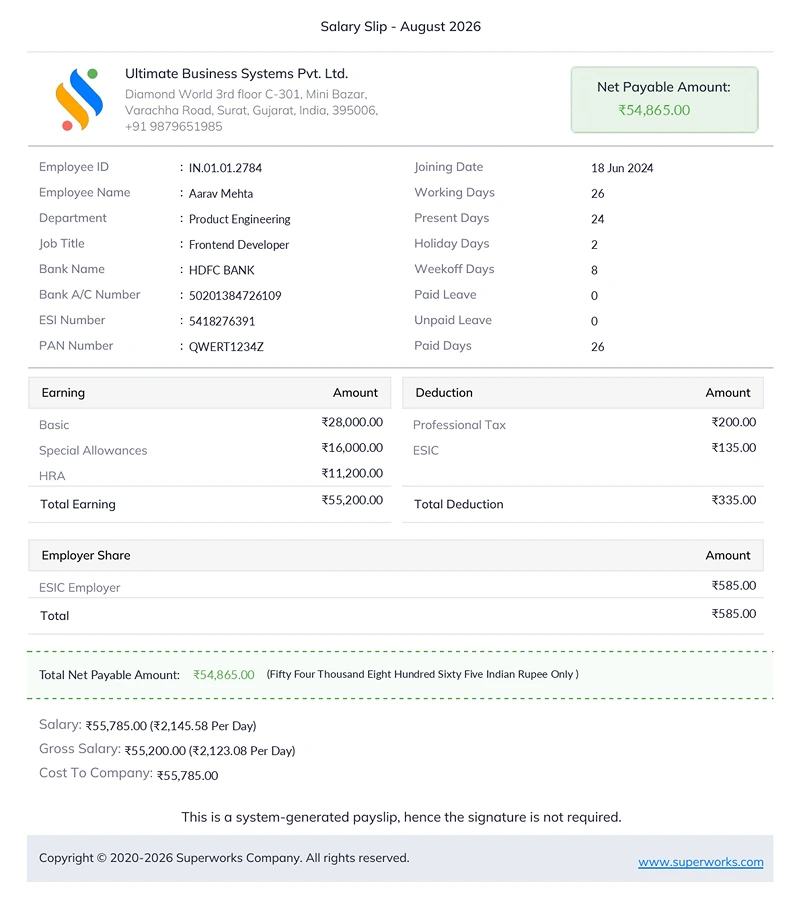
1. Employer details:
The company’s name, logo, registered address, and often its PAN or GSTIN, confirming which organization issued the payslip.
2. Employee identity:
The employee’s name, employee code, designation, department, and date of joining, used to uniquely tie the payslip to the right individual.
3. Bank details:
The employee’s bank account number and IFSC code, so that the net salary will be credited to that account.
4. Attendance:
Total working days, days present, leave taken, and any loss-of-pay days for the month.
5. Basic salary:
The foundation of the salary structure, usually 35–40% of total CTC. Every other allowance is calculated as a percentage of this figure.
6. House Rent Allowance:
Paid to help cover housing costs; the amount varies by city. Employees can claim tax exemption on the lowest of.
7. Dearness Allowance:
A cost-of-living adjustment, typically 30–40% of basic salary, and fully taxable. DA mainly applies to government and public-sector employees; most private-sector employers don’t include it.
8. Transport Allowance:
Paid to help offset an employee’s daily commuting costs. It’s fully taxable as part of salary, though some employers structure it as a reimbursement instead.
9. Medical Allowance:
Helps cover routine healthcare costs. Since the 2018 Budget, this has largely been folded into a standard deduction of ₹50,000 per year rather than a separate exempt line item.
10. Tax Deducted at Source:
Tax deduction is income tax that the employer deducts directly from the employee’s monthly income and deposits with the tax department.
11. Employees’ Provident Fund:
A mandatory retirement savings contribution. The employee contributes 12% of basic salary, matched by an equal employer contribution, with the employee’s share deductible under Section 80C.
12. Professional Tax:
A state-level tax on employment income, applicable only in certain states, with slabs that vary by state and are revised periodically.
13. Employees’ State Insurance:
A statutory contribution toward medical and cash benefits for employees below a specified salary threshold, deducted from the employee and matched by the employer at a higher rate.
14. Labour Welfare Fund:
A small, state-mandated contribution that funds welfare schemes for the labour workforce; applicability, amount, and frequency vary by state.
15. Gross Salary:
Gross pay is the sum of all earnings (basic salary, HRA, DA, allowances) before any deductions are applied.
16. Net Salary:
Gross Salary minus total deductions – the actual take-home amount credited to the employee’s bank account, shown in both figures and words to avoid ambiguity.
17. Year-to-Date summary:
A running total of earnings and deductions from the start of the financial year up to the current pay cycle, useful for tracking annual income and tax liability without pulling up every individual payslip.
How to download your payslip online?
Chasing HR over email for a copy of last month’s payslip is a thing of the past. With an HRMS and payroll software, employees can access payslips on their own. All they have to do is follow some steps:
- Log in to your HR or payroll platform.
- Go to the “Salary” section.
- Go to the “payslip generation” section
- Select the month and year.
- Download the salary slip. You can also get an e-payroll payslip in your email.
What should a salary slip format include?
When it comes to salary slip format, the following are the components included.
- Month and year of the payslip
- Company name, logo, and registered address
- Employee name, employee code, designation, and department
- PAN/Aadhaar number and bank account details
- Total working days and leave taken
- EPF number and UAN
- Complete earnings breakdown
- Complete deductions breakdown
- Net pay in numbers and words
| Component | Amount |
|---|
| Basic Salary | ₹XX, XXX |
| HRA | ₹XX, XXX |
| DA | ₹X, XXX |
| Transport Allowance | ₹X, XXX |
| Medical Allowance | ₹X, XXX |
| Gross Salary | ₹XX, XXX |
| TDS | ₹X, XXX |
| EPF | ₹X, XXX |
| Professional Tax (PT) | ₹XXX |
| ESI | ₹XXX |
| LWF | ₹XX |
| Total Deductions | ₹X, XXX |
| Net Salary | ₹XX, XXX |
Software-generated format
An automated salary slip generator produces a customized PDF without the need for a manual calculation.
How does payroll software make payslip generation efficient?
Basically, when someone says payroll processing, it covers everything- tracking of attendance, leave, & shifts, applying tax rules, calculating deductions, disbursing salaries, and staying compliant with the state and central laws. The payslip is simply the final document of that process.
When payroll runs on disconnected spreadsheets or manual entry, payslip errors are common. When the payroll process happens on payroll software, data flows directly into the salary calculation, so that the generated payslip is accurate. If you’d rather not prepare payslips and statutory deductions yourself, a Payroll service in india can generate accurate salary slips every month.
Conclusion
By now, you must have understood the value a salary slip holds. For employees, it is an essential document that plays a key role when they go to apply for a loan, negotiate with another company when applying for a job, and even apply for a visa. The problem is that in a country like India, most of the companies, even today, don’t provide salary slips to their employees.
And even if they do, the process is done manually. This increases the chances of mistakes. The result? Confusion and disputes. As part of statutory compliance, providing salary slips is mandatory. Now, if you want to save time and avoid the stress of creating them manually, then check out Super Payroll by Superworks.
It automates and centralizes the entire payroll process and compliance management. Plus, you can generate salary slips instantly and enable employees to view/download them in just a few clicks. Book a demo today.