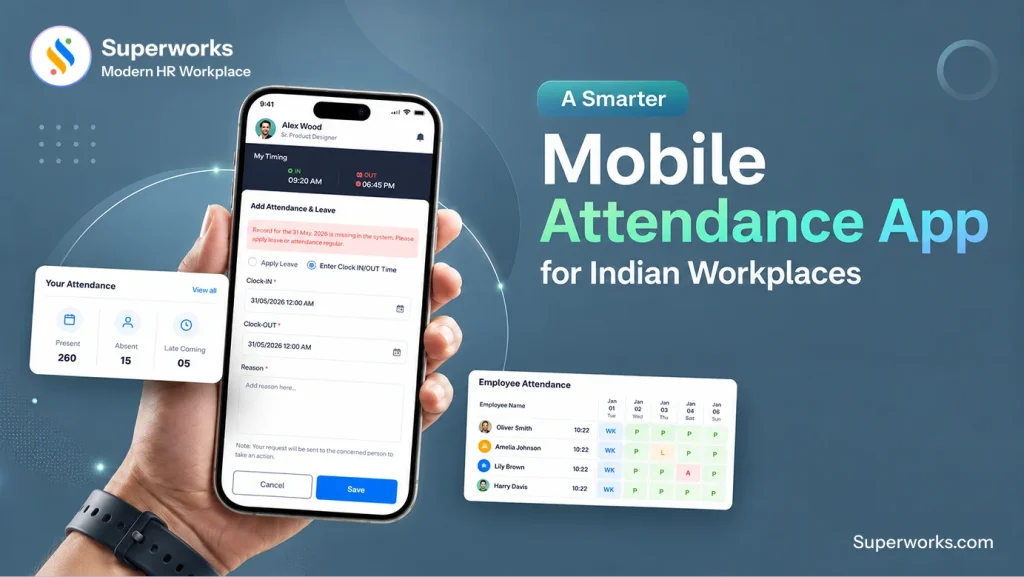
TL; DR
Indian businesses managing field or distributed teams are paying a hidden tax in wasted hours, payroll errors, and proxy attendance by sticking to biometric machines. A mobile attendance app with geo-fencing, facial liveness detection, offline mode, and native payroll integration fixes all four. This page breaks down what to look for, how the top platforms compare, and what the integration with payroll actually looks like in practice.
There’s a reason why Indian businesses are quietly moving away from biometric machines and switching to a mobile attendance app instead.
Because attendance management is no longer just about knowing who showed up to work.
It’s about managing field teams spread across cities. It’s about verifying attendance without creating friction and ensuring payroll doesn’t collapse into chaos at the end of every month.
And more importantly, it’s about building a process that actually scales.
A traditional biometric setup was designed for a workforce that worked from one office, one location, and one shift pattern. But that’s no longer how Indian businesses operate now. Today’s workforce is mobile, distributed, hybrid, shift-based, and often spread across multiple client sites or branch offices.
That’s where a modern mobile attendance system changes the equation.
This guide will talk about the mobile attendance app in-depth because the question is no longer whether businesses should move to mobile attendance. The real question is which platform can handle the operational complexity without creating more of it.
Why geo-fenced mobile attendance beats biometric machines?
Let’s get real here for a minute!
Yes. It is true that biometric machines had their moment once. But now that moment has passed. And in 2026 at least, it is not considered the only solution for Indian businesses managing distributed teams.
Here’s what a biometric machine actually requires: every employee must be physically present at a fixed device, at a fixed location, at a fixed time.
So, for instance, biometric machines can work well for a company with a strength of 30 employees. But for a company with 200-500 employees, especially if they have a sizeable team of field employees, in that case, this would be a little impossible.
The cost argument is equally straightforward:
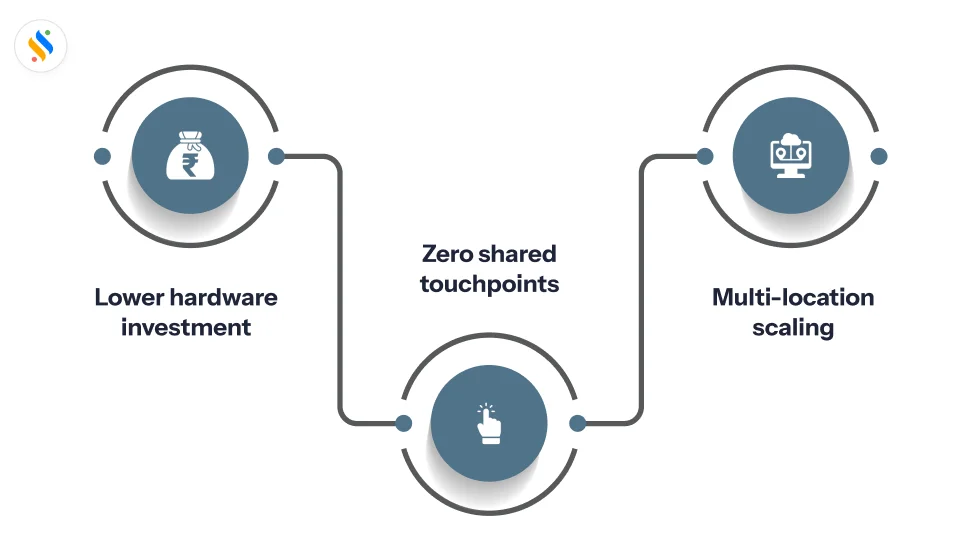
The cost of a single biometric device in India ranges between ₹15,000 and ₹35,000, including installation and maintenance.
Multiply that across 10 branch offices, and you’re looking at a capital expenditure that a mobile attendance system eliminates entirely. Because it enables every employee to carry the hardware in their pocket.
The hygiene argument became impossible to ignore:
Dozens of employees pressing the same sensor every morning is now a real operational concern for HR managers, not just a theoretical one. A selfie attendance app or geo-based check-in removes shared contact from the equation entirely.
The scalability argument is where it gets interesting for founders:
When you hire your 51st employee in a city where you don’t have an office, a biometric machine forces you to either open a physical location. A mobile attendance system lets you set a geo-fence around a client site, a co-working space, or a specific locality and attendance management scales with your headcount.
The shift to geo-fenced mobile attendance isn’t a technology preference. For Indian SMBs managing hybrid or field-based teams, it’s a structural requirement.
Pairing the app with a full attendance management system ensures geo-fenced punches, shifts, and leaves are tracked and reported in one place.
5 features every mobile attendance app needs
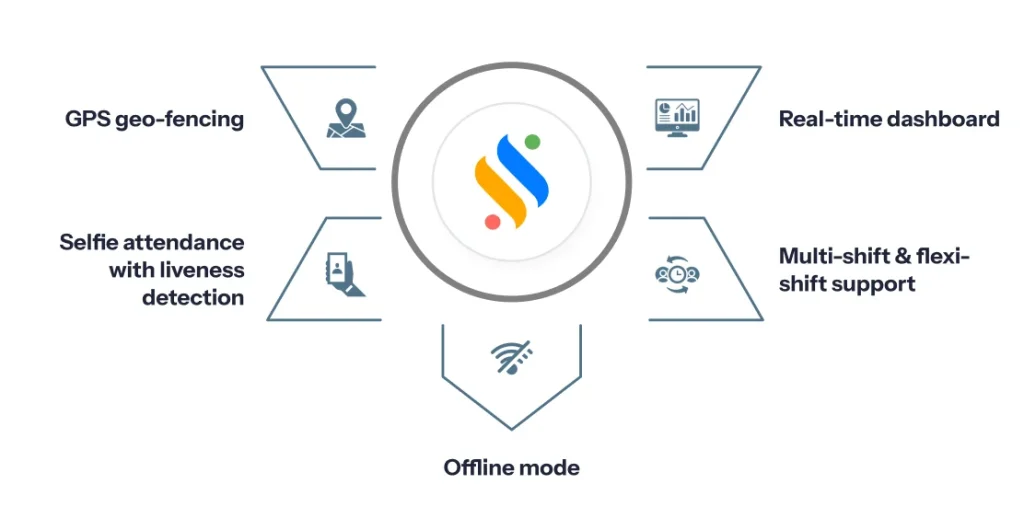
Not all attendance tracker apps are built the same. Many look impressive in a product demo and fall apart the moment a field employee enters a low-connectivity zone. That’s why, before committing to any platform, run it against this checklist.
GPS geo-fencing with configurable radius:
The attendance app must allow you to define attendance zones, meaning whether that’s a 100-metre radius around your office or a client’s premises. Employees should only be able to mark attendance when they’re physically within that boundary.
Bonus tip: Look for apps that log GPS coordinates at the time of punch-in, not just a yes/no verification. That way, you will be audit-ready in case any dispute arises.
Selfie attendance with liveness detection:
A selfie attendance app that doesn’t verify liveness is just a photo upload. Modern mobile attendance systems use liveness detection. A slight head movement or a prompt blink will prevent proxy attendance via a stored photograph. This is especially effective in managing the attendance of the field employees, where managers can’t physically present to supervise employees’ check-in.
Offline mode with sync-on-reconnect:
Interestingly, most HR managers either don’t bother to ask about this feature or are completely unaware of this. Field teams that operate in low-network zones cannot depend on uninterrupted internet access. The app must allow them to mark attendance offline and sync automatically when the connection is restored with the original timestamp intact.
Multi-shift and flexi-shift support:
An HRMS mobile attendance feature built only for a 9-to-5 structure is useless, especially for industries like retail, hospitality, healthcare, or manufacturing companies, where operations happening in two, three, or shifts is common. The app needs to handle shift definitions, shift rotations, and edge cases like night shifts that cross midnight.
Real-time manager dashboard:
Want to know what historical reporting looks like? Try downloading attendance at the end of the day in a CSV format! A useful employee attendance app gives shift supervisors and HR managers a live view – who’s in, who’s late, who hasn’t punched in yet. So that they can act in the moment rather than audit after the fact.
The best HRMS software offers the best mobile app for attendance
Choose Super HRMS as your attendance app for seamless management
Attendance management software helps businesses automate clock-ins, shift schedules, and leave tracking in one place. Paired with a mobile app, it gives HR teams accurate attendance data for every location.
Offline mode, multi-shift, and roster integration: What field employees actually need?
If your workforce sits at desks in air-conditioned offices, any reasonable attendance app will serve you adequately. But if you’re managing field sales teams, delivery personnel, construction site staff, or factory floor workers, the requirements are fundamentally different, and most generic apps quietly fail them.
Offline mode is survival, not a feature:
A field employee driving between customer visits in a semi-urban territory will lose signal. A construction supervisor doing rounds in a basement or an underground parking facility will lose signal. The mobile attendance system must record the punch with a local timestamp and push it to the server the moment connectivity returns. Without this, you’ll have attendance gaps that look like absences and create payroll disputes you don’t have time to resolve.
Roster integration is the connective tissue between planning and execution:
Most mid-sized Indian businesses – particularly in logistics and manufacturing work with weekly or monthly rosters that define who works which shift on which day. A mobile attendance app that doesn’t integrate with your roster is just collecting data without context. With integration, the system knows that Ramesh is scheduled for the B-shift on Thursday, so a check-in at 6 PM is on time, not three hours late.
Multi-shift logic also affects overtime and compliance:
India’s labour laws – and several state-level Shops and Establishments Acts – have specific provisions around overtime calculation, rest periods between shifts, and maximum working hours. An attendance system that doesn’t understand shift boundaries can’t calculate these accurately, which creates both payroll errors and compliance exposure.
For geo attendance app use cases in field sales:
The combination of GPS verification, offline capability, and roster awareness is what separates a tool that your team will actually use from one they’ll find workarounds for within a week.
Mobile attendance + payroll: The integration story
Attendance data is not the end goal. Payroll accuracy is.
Every HR manager reading this knows the pain of month-end reconciliation: pulling attendance logs from one system, leave records from another, overtime approvals from a WhatsApp thread, and trying to make them all agree before salary processing begins. It’s the kind of work that takes two days of effort and produces errors anyway.
A mobile attendance app connected directly to your payroll engine changes that data flow entirely.
Here’s how the integration works in a well-built HRMS: the attendance module captures daily records – present, absent, late, half-day, on-duty – and feeds them in real time to a payroll calculation engine. Leave balances update automatically when an employee marks an absence. Overtime hours, calculated against shift definitions, are flagged for manager approval and then flow directly into the salary computation. Loss of Pay is calculated against the actual number of working days and deducted without manual intervention.
The result: by the time the payroll run begins, the data is already clean. Your HR team is approving numbers rather than building them from scratch.
For Indian SMBs, this integration also simplifies statutory compliance. PF, ESI, and professional tax calculations depend on accurate attendance and earnings data. When attendance feeds directly into payroll, the compliance calculations run on verified numbers – not on figures that have been manually keyed in from a printout.
The broader point for C-level executives is this: the ROI of a mobile attendance system is not just the time saved in recording attendance. It’s the compounding efficiency across every downstream process that attendance data touches – payroll, compliance, leave management, and workforce planning.
Comparison of the top 5 mobile attendance apps in India
The Indian HRMS software market has matured significantly, and most platforms now offer geo-fencing and selfie check-in as baseline features. The real differences show up in the details: how each app handles offline scenarios, how deeply attendance connects to payroll, and which workforce size and type each platform is actually built for. Here’s what the research shows across five platforms that consistently appear on Indian HRs’ lists.
| Features | Superworks | greytHR | Keka | HROne | Zimyo |
|---|
| Geo-fencing | Geo-tagging, geo-fencing & geo-tracking | Configurable geo-fence with auto sign-in/out | GPS geo-fencing with continuous location punching | Geo-tagging & geo-fencing | GPS-based geo-fencing & geo-tagging |
| Selfie attendance | Selfie + face scan attendance | Selfie with liveness detection | Selfie clock-in + facial recognition | Selfie attendance | Selfie attendance |
| Multi-shift support | Multiple shifts, shift roster & rotation | Yes | Advanced shift management | Multi-shift policies & bulk approvals | Automated shift tracking & roster management |
| Payroll integration | Native — attendance feeds directly into payroll | Native HRMS | Native — attendance connects to Keka Payroll | Native — zero-integration setup within the same platform | Integrated HR ecosystem |
| Live manager dashboard | Interactive dashboards with live tracking | Real-time attendance audit trail | Real-time dashboard | Real-time dashboards & analytics | Real-time tracking & reporting |
| Indian statutory compliance (PF/ESI) | Auto TDS, statutory compliance, Form 16 | Strong compliance, muster roll generation | Tax handling, payroll compliance | Built-in Indian labour law compliance | Statutory compliance management |
| Best suited for | SMBs, field teams, all-in-one HRMS + PMS | Mid-to-large enterprises, manufacturing, and healthcare | Growing businesses, distributed & hybrid teams | Mid-sized businesses, compliance-heavy industries | SMBs, retail, education, field teams |
The comparison makes one thing clear: geo-fencing and selfie attendance are now standard. What differentiates platforms is the combination of offline reliability, roster intelligence, and how tightly attendance data connects to payroll and compliance, and which of those dimensions matters most depends entirely on your workforce type.
Conclusion
A mobile attendance app is no longer just an HR convenience feature. For Indian businesses managing field teams, multiple branches, rotational shifts, or hybrid workforces, it has become operational infrastructure. Because attendance doesn’t exist in isolation anymore. It directly affects payroll, overtime calculations, compliance, and others. But when an attendance system breaks down, every downstream process breaks with it. That’s why the conversation has shifted beyond basic punch-in and punch-out tracking. Today, businesses need a solution that can verify location through geo-fencing and prevent proxy check-ins through selfie verification. And this is exactly where most generic tools start falling apart.
Some platforms offer GPS tracking but struggle with offline mode. Others manage attendance well but create friction when payroll processing begins. Very few work perfectly for office teams but fail the moment shift rotations and field staff enter the picture. That’s precisely why thousands of Indian businesses now prefer an employee attendance app like Super HRMS, because it doesn’t treat attendance as a standalone feature. It treats it as the foundation for everything that comes after it.










