TL; DR
Not all HRMS software is the same. That’s why this article focuses on the types of HRMS software. The in-depth classification has been done based on deployment, audience size, scope, and diverse industries. Read this guide so that you can have the right type of HRMS software for your business.
Whenever a manager, a C-level executive, or an MSME founder says, “We need HRMS software for our business”, the discussion ends there – full stop. And that’s where the problem begins. They are unaware of the fact that HRMS software isn’t just a product; it’s a category in today’s day and age. Within those categories are different types of HRMS software. And it’s essential to have a thorough knowledge and understanding of that, so that you don’t end up wasting money. This will also affect your day-to-day HR operations. This guide gives you a complete HRMS classification, so that before you end up saying “yes” to any vendor, you know what you are paying for!
Types of HR software by deployment
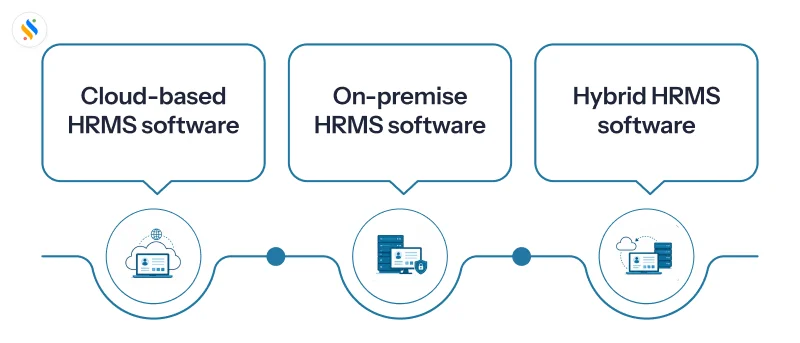
These types of HRMS software are usually about where they live.
Cloud-based HRMS software
HRMS software vendors host Cloud-Based HRM Software on their servers. They also ensure that employees can access it easily from their desktop systems and mobile apps. The best part is that there is no need for hardware installation or an IT team to set up the system. All the updates keep happening automatically.
How does it work?
The company needs to have their own hardware. Only then can the in-house IT team manage data management and employee data management effectively.
Pros:
- System setup is not complex.
- Automatic updates available.
- Accessible from different devices and from locations too.
- Pay-as-you-go pricing available, which is best in the SaaS domain.
Cons:
- Requires a stable internet connection
- Data lives outside your premises (important for DPDP Act compliance)
- Limited customization compared to on-premise
Best for,
Businesses that are looking for a quick setup and implementation at a low cost, along with accessibility for remote teams.
When to choose a Cloud-based HRMS software?
- Your business is scaling.
- You don’t have a budget to set up an in-house IT team.
- Need a solution to manage remote-based teams.
On-premise HRMS software
This HRMS software gets installed directly on the company’s own servers. The company’s IT team manages its entire infrastructure and ensures that all the data remains secure.
How does it work?
The company needs to have their own hardware. Only then can the in-house IT team manage the data effectively.
Pros:
- Full control over data.
- No dependency on vendor uptime.
- Higher customization potential.
- Better suited for organizations with strict data residency requirements.
Cons:
- High upfront infrastructure cost.
- Requires a dedicated IT team.
- Slower to implement and update.
- Scaling requires additional hardware investment.
Best for,
Businesses where sharing data outside the premises is non-negotiable.
When to choose an on-premise HRMS software?
If your business falls under an industry that is heavily regulated, on-premise Types of HRMS software is the right option for you.
Hybrid HRMS software
As the name implies, hybrid HRMS software combines the functionalities of both models. Only either core HR data or sensitive information related to the payroll will be stored on the on-premise HR software. Other than that, everything will run on the cloud.
How does it work?
The sensitive data will reside on the on-premise software, while all the other functions will run on the cloud.
Pros:
- Sensitive data stays within your premises, supporting DPDP Act compliance.
- Cloud features keep employees and managers connected from anywhere.
- Easier to migrate gradually from on-premise to cloud over time.
- Reduced risk compared to full cloud migration in one go.
Cons:
- More complex to implement and maintain than either model alone.
- Requires both an IT team and a reliable internet setup.
- Integration between on-premise and cloud components can create sync issues.
- Higher total cost compared to pure cloud solutions.
- Vendor support can be harder to manage across two environments.
Best for,
Mid-to-large enterprises need a solution that is flexible in nature, so that they don’t need to move their entire data off-premise.
When to choose a Hybrid HRMS software?
This is one of the most practical types of HRMS software when you are managing both remote and in-office teams and need unified attendance, payroll, and Hr compliance software tracking.
Not sure which HRMS software is best for you?
Thousands of Indian businesses have trusted Super HRMS. It's your time!
Types of HR software by audience
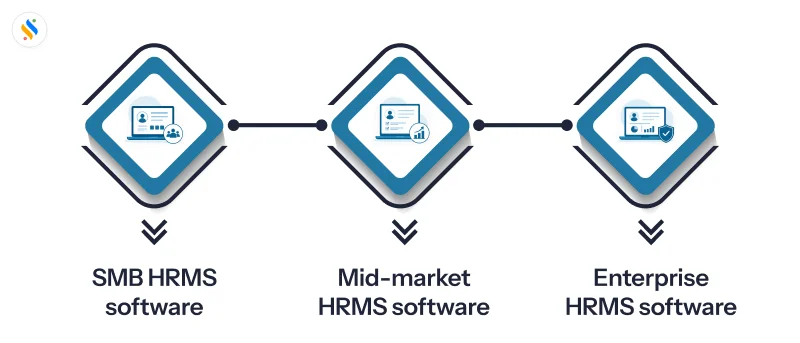
Now that you know how data can be hosted, the next step is understanding which types of HRMS software are built keeping the organization’s size in mind. Features of hr software is for an MSME works very differently from software designed for an enterprise. The difference lies in feature depth, pricing, and implementation complexity.
SMB HRMS software [Under 50 employees]
SMB HRMS software, or Small Business HRMS software are designed keeping the business requirements of MSMEs in mind. Therefore, it covers the essential HR functions – maintaining employee records, tracking attendance, approving/rejecting leave, and basic payroll. This way, businesses that don’t have an HR department can perform their operations efficiently.
Key features:
- Centralized employee database
- Attendance and leave tracking
- Basic payroll processing with PF, ESIC, and TDS calculations
- Document storage and management
- Employee self-service portal
- Mobile app access
- Basic compliance reporting
Pricing band:
~ ₹70/employee/ month
Right option for you if,
You don’t have a budget to add an HR department, and you are looking for a smart solution without breaking your bank.
Mid-Market HRMS software [50-500 employees]
As mentioned, this software caters to the companies that have a healthy workforce. This means that the functionalities of the software also go beyond the basics. The features will include everything a scaling business needs when HR complexity starts affecting the business.
Key features:
- Everything in SMB HRMS
- Automated payroll with full statutory compliance (PF, ESIC, TDS, PT, Form 16)
- Shift and roster management
- Performance management with goal setting and appraisal cycles
- Applicant tracking and recruitment workflows
- Onboarding and offboarding automation
- Multi-location and multi-branch support
- HR analytics and dashboards
- Expense and reimbursement management
- Configurable workflows and approval chains
Pricing band:
~ ₹100/employee/ month
Right option for you if,
Your workforce is growing, and your HR team is looking for a solution that makes the HR operation efficient and keeps the business compliant, too.
Enterprise HRMS software [500+ employees]
Enterprise HRMS software is built for scale and to deal with complexities with efficiency. It handles large workforces across multiple geographies, supports advanced workforce analytics, and often includes making the hiring operation super efficient with an innovative solution.
Key features:
- Everything in mid-market HRMS
- Multi-entity and multi-geography payroll
- Advanced workforce analytics and AI-driven insights
- Talent acquisition and succession planning
- Learning management system (LMS)
- OKR-based performance management
- Custom role-based access control
- Integrations with other tools
- Strategic workforce planning
Pricing band:
The pricing band here is fully customizable.
Right for you if,
You have a huge workforce, complex HR hierarchies, or need deep integration with your existing system without disrupting your workflows.
Types of HR software by scope
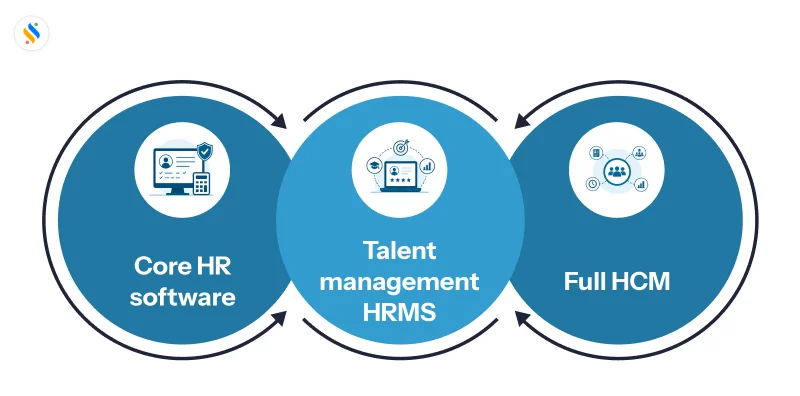
Beyond size, scope is another important factor when comparing the different Types of HRMS software. Some systems handle only core HR tasks, while others cover talent, performance, and long-term workforce strategy.
Core HR Software
Core HR software handles the basic administrative tasks like employee records, attendance, leave, basic payroll, and others. It is the foundation of any human resource management system, and the starting point for businesses automating their HR processes for the first time.
What it includes:
- Centralized employee database with org chart and lifecycle tracking.
- Attendance and leave management with PF, ESIC, and TDS automation.
- Basic payroll processing with payslip generation and Form 16.
- Document storage and management.
- Employee self-service portal and mobile app.
- Onboarding and offboarding workflows.
- Basic compliance reporting.
- Role-based access control.
Many Core HR platforms now go a step further with a dedicated HR App for Employees, letting staff check attendance, apply for leave, and view payslips directly from their phones.
Who it is for:
Organizations automating their HR operations for the first time, or small businesses that do not need advanced HR functionality yet.
Talent Management HRMS
Talent management HRMS adds recruitment and performance management on top of core HR. It is for organizations that are actively hiring, managing performance cycles, and building internal talent pipelines.
What it includes:
- Everything in Core HRMS
- Applicant tracking system with resume parsing and candidate ranking
- Structured onboarding with digital document collection
- Goal setting, continuous feedback, and 360° performance reviews
- Shift scheduling and roster management
- Employee engagement, surveys, and pulse checks
- Training and development tracking
- Expense and reimbursement management
- Configurable approval workflows
- HR analytics dashboards with workforce insights
Who it is for:
Growing companies where hiring and performance management are top priorities.
Full HCM (Human Capital Management)
Full HCM treats employees as strategic assets and includes everything from core HR to leadership development.
What it includes:
- Everything in Talent Management HRMS
- Succession planning and career pathing
- Learning management system with course tracking
- Compensation planning and variable pay management
- Strategic workforce planning across entities and geographies
- Multi-country payroll with local statutory compliance
- Real-time reporting & analytics
Who it is for:
Large enterprises where HR strategy is directly tied to business outcomes and long-term workforce planning.
Types of HR software by industry
While generic HRMS covers basic operations for most businesses, every industry has its own HR challenges. That is why these types of HRMS software exist that are industry-specific. The operational needs of manufacturing are very different from those of IT, retail, or BFSI.
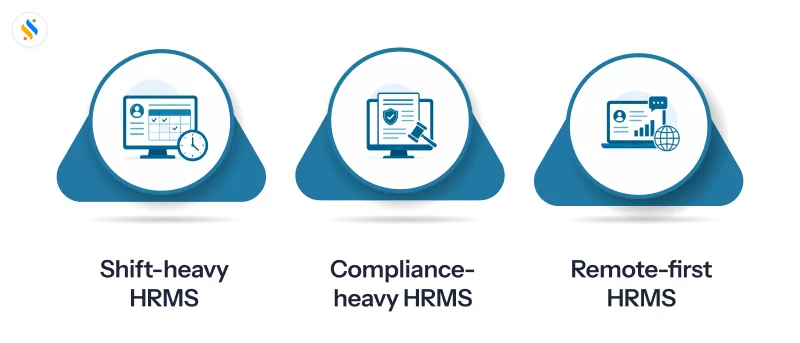
Shift-Heavy HRMS
If you Google the list of industries where shift operations are a major concern, you will easily see manufacturing and BPO in the top two. Workers clock in at odd hours, rotate across shifts weekly, and overtime needs to be tracked and compensated accurately. Employee turnover in these sectors is also high, making workforce management a critical function.
What vertical HRMS adds:
- Multi-shift scheduling and roster management
- Biometric and machine-level attendance integration
- Overtime and night shift allowance automation
- Contract and daily wage worker management
- Factory Act and S&E Act compliance
Compliance-Heavy HRMS
Because the nature of work in hospitals and healthcare is such that they need to be on their toes 24/7, shift rostering is equally true for this industry. Healthcare workers work in round-the-clock rosters. In addition to this, there are regulatory requirements for the workforce that institutions need to be mindful of.
What vertical HRMS adds:
- 24/7 shift management across departments
- Credential and certification tracking
- Duty hour compliance and fatigue management
- Separate payroll structures for permanent vs contract staff
- ESIC and healthcare-specific statutory compliance
Multi-Location HRMS
Retail chains and restaurants manage their locations across different locations — sometimes within the border and sometimes across borders too. Each chain has its own staff, shift patterns, and payroll. Visibility across all locations from a single dashboard is non-negotiable, especially when managing employee data across hundreds of stores.
What vertical HRMS adds:
- Multi-store attendance tracking and shift management
- Part-time and gig worker payroll support
- High-volume onboarding for seasonal hiring
- Location-wise payroll and compliance reporting
- Employee churn tracking and exit management
Remote-First HRMS
Banks, NBFCs, and educational institutions operate under heavy regulatory oversight. Their HR systems need to be audit-ready at all times, with strict access controls and compliance documentation. For HR professionals in these industries, reducing the administrative burden while staying compliant is the core challenge.
What vertical HRMS adds:
- Remote attendance via geo-fencing or IP-based punch-in
- Flexible shift and work-from-home policy management
- Project-based performance tracking
- ESOP and variable pay management
- Integration with tools like Slack.
Regulated-Industry HRMS
Banks, NBFCs, and educational institutions operate under heavy regulatory oversight. Their HR systems need to be audit-ready at all times, with strict access controls and compliance documentation.
What vertical HRMS adds:
- Role-based data access with audit trails
- Compliance documentation and digital record keeping
- Regulatory reporting for RBI, SEBI, or other requirements
- Background verification workflow integration
- Strict data security and DPDP Act compliance
Which type of HRMS fits your business?
The best way to answer this question is to go through the set of these five questions. It is because when you are able to answer these questions, you might have an increased possibility of getting the right type of HRMS software that will meet all your business requirements.
Question 1: Where do you want your data hosted?
- On your own servers
- Fully online, no IT setup
- Mix of both
Question 2: How big is your organization?
- Under 50 employees
- 50–500 employees
- 500+ employees
Question 3: What do you primarily need the software for?
- Employee records, attendance, and payroll
- Above + recruitment and performance management
- Everything, including workforce planning and analytics
Question 4: Do you operate in a specific industry?
- Manufacturing or BPO
- Healthcare or hospitals
- Retail or F&B
- IT or SaaS
- BFSI or education
Question 5: What is your biggest HR priority right now?
- Cut manual administrative tasks
- Stay compliant with PF, ESIC, and TDS.
- Improve employee experience
- Get workforce insights
Before you commit to any platform, it’s important to understand How to Choose HRMS Software — the right evaluation framework ensures you select a system that fits your business size, industry needs, and budget without overpaying for features you don’t need.
Conclusion
The saying that one size fits all might work anywhere, but not in the case of HR software. The conventional belief has always been that there is always an Types of HRMS software, and that’s it. But no, that’s not it. There are different types of HRMS software, and each one of them serves different purposes. Whether you need a lightweight human resource information system for a small team or a full human capital management suite with benefits administration, payroll automation, and predictive analytics, the right choice comes from understanding your own business first. And speaking of that, if you are looking for a solution that not only automates repetitive administrative tasks, but also makes your entire hr operations efficient, then Super HRMS by superworks is what you might need. From onboarding & offboarding and attendance management to generating workforce analytics in real-time, Super HRMS takes care of everything, so that your HR and employees work productively and the entire operation becomes smooth. Before you commit to any platform, it’s worth taking a moment to understand what is HRMS software at its core — because knowing the fundamentals helps you match the right type of HRMS to your specific organizational needs. So, give it a shot. Get Super HRMS. Book a demo!










