TL;DR
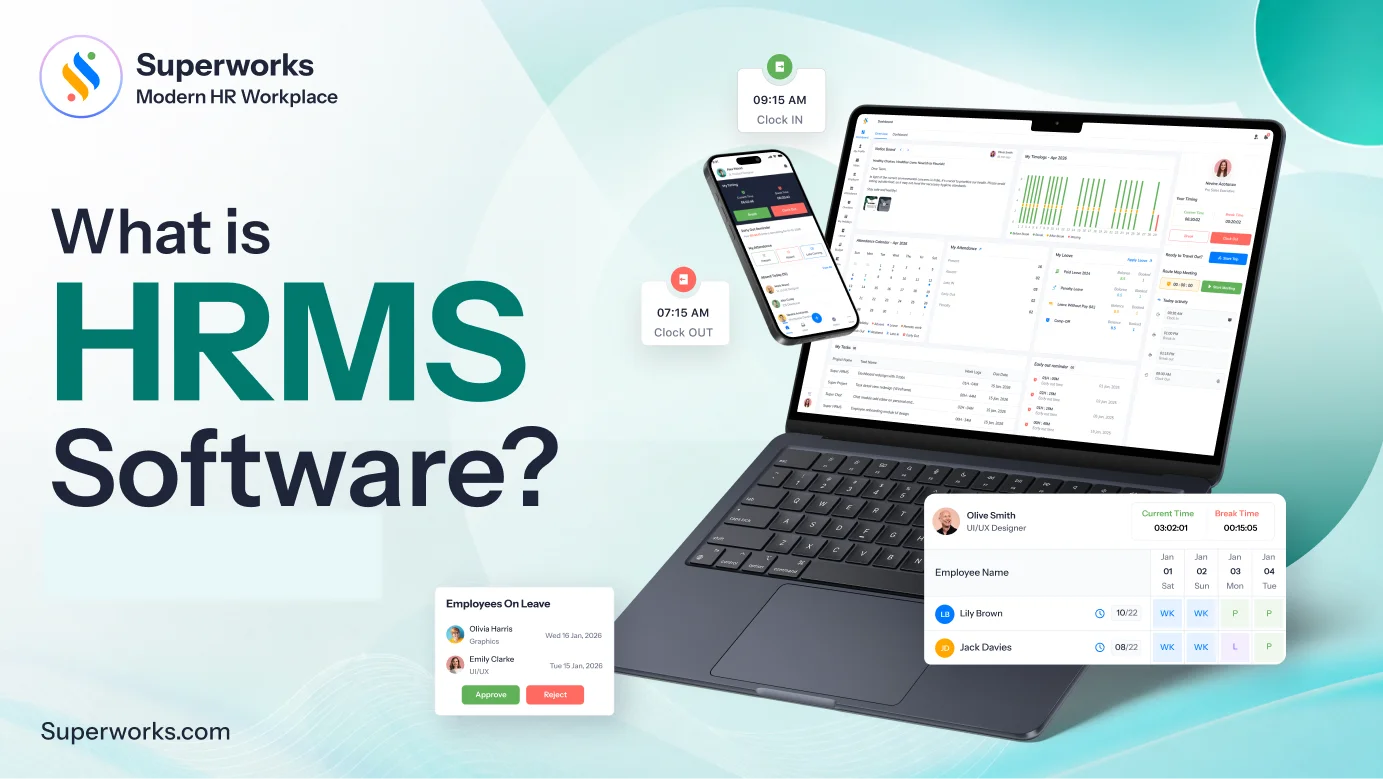
What is HRMS software? A smart HR software that automates repetitive tasks and streamlines the entire HR operations. It centralizes employee data, so that there is minimal human intervention. This means fewer errors, and HR operations can run with great efficiency. And for better HR efficiency, get Super HRMS by Superworks.
Those days are gone when the job of HR professionals was limited to managing employee records or processing payroll at the month-end. In 2026, modern HR teams are expected to do much more. This shift is also driven by the rise of distributed work models, including remote and hybrid setups.
Challenges begin to emerge when core HR operations such as attendance, payroll, leave management, shift scheduling, employee engagement, performance management, and compliance are handled manually. Even small errors—something that is inevitable—can lead to significant compliance and operational issues for HR teams and HR leaders alike.
This is why there is a growing need for a smart solution that not only ensures compliance but also plays a key role in improving workforce efficiency. The answer is HRMS software.
This guide explores what HRMS Software is, what it stands for, the core modules it includes, how it compares with HRIS and HCM, and how it actually works in practice.
HRMS software definition:
What is HRMS software? To answer this question, it is important to understand its definition. HRMS software is a software that digitizes, automates, centralizes, and streamlines the entire core HR-related and administrative tasks, making it an effective HR solution.
What does HRMS software stand for, and what does it do?
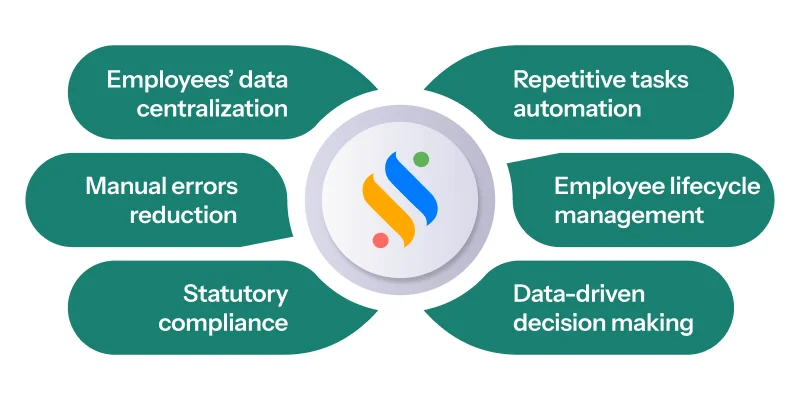
HRMS full form is Human Resource Management System. Speaking of what it does, here is a list:
Centralization of employees’ data:
One of the most fundamental things HRMS software does is that it centralizes all your employee data. Instead of maintaining employees’ personal information, attendance, leaves, payroll, and shifts on a spreadsheet, HRMS software brings them all on one centralized system. This way, every detail remains secure, and the right person across the HR department can access it easily.
Automation of repetitive tasks:
Whether it is collecting documents from new candidates onboarding or approving their leave, when every HR process runs through the same system, things stop falling through the cracks. Types of hrms software connects all the workflows so they run in a structured, consistent, and predictable way.
Reduction of manual errors:
Errors are inevitable when there is a human intervention to perform certain tasks. what is HRMS software eliminates these risks by automating calculations, validating data entries, and maintaining accurate records at every step.
Employee lifecycle management:
From onboarding to offboarding, HRMS software seamlessly manages the entire employee lifecycle. Both the operations – onboarding and offboarding become faster and more efficient. This way, employees have a smoother experience, and HR teams can work without unnecessary stress.
Ensuring statutory compliance:
In India, whether you are an MSME founder or a C-level executive of an Indian business, staying compliant with the rules and regulations is mandatory for you. HRMS software’s payroll processing and compliance ensure that PF, ESIC, TDS, PT, and other compliances are calculated correctly and filed on time. This way, businesses remain compliant and secure from legal troubles.
Enabling data-driven decision making:
With HRMS software, HR teams and managers can generate accurate, real-time workforce reports and data analytics with ease. Access to reliable data-driven insights helps them identify and understand aspects like absenteeism trends and attrition rates, and make more informed, data-driven decisions. Some modern HRMS platforms even apply predictive analytics to flag risks before they become problems.
The best way to manage HR operations is here!
Super HRMS automates your entire HR operations and makes it efficient.
Core HRMS modules:
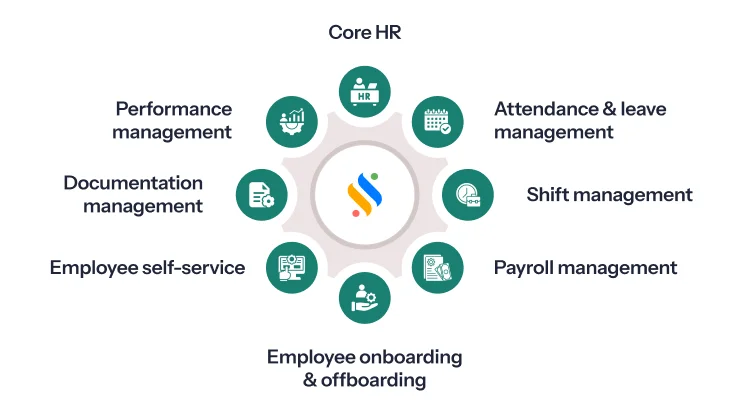
HRMS software is a complete suite of different modules, and each one handles a specific area related to HR operations. Here is a quick look at what each of the modules does:
Core HR:
Centralizes the entire workforce database and seamlessly manages the complete employee lifecycle, from hiring to retiring. It forms the backbone of all core HR functions.
Attendance & leave management:
Employees can clock in, apply for a break, and clock out with just a click. They can even track them. Employees can also apply for leave and can check their balance and managers can approve/reject them easily.
Shift management:
The software helps managers and HR in creating, assigning, scheduling, and rotating shifts in real-time. They can even track working hours to ensure compliance, which is a key part of effective workforce management.
Payroll management:
The software ensures accurate, on-time payroll processing with full statutory compliance with PF, ESIC, TDS, and professional tax, reducing payroll errors through automated salary calculations.
Employee onboarding & offboarding:
From new candidates onboarding to existing employees leaving the organisation, each process became seamless and hassle-free.
Employee self-service:
Employees can perform basic HR tasks on their own, like access payslips, update their personal details, apply for leave, and access HR policies. Thus, reducing dependency on HRs.
Documentation management:
Instead of physical copies of HR documents, the software stores them in a digital format and keeps them organized, secure, and accessible.
Performance management:
Instead of relying on spreadsheets to track employees’ performance, the software brings structure, data, and fairness to goal setting, progress tracking, and appraisal cycles.
HRMS vs HRIS vs HCM: which one are you actually buying?
One of the biggest mistakes that managers often make is that they think all three terms are actually the same, making them to use the term interchangeably. But they are not the same, and each one has distinct features associated with it. And the more clarity one has, the better. So let’s understand each of them.
What is HRIS?
An HRIS (Human Resource Information System) is a software that centralizes, stores, and manages core HR processes. By eliminating manual paperwork, it helps HR work more efficiently.
Core functions:
- Employee information management
- Attendance records
- Leave management
- Payroll data storage
- Document management
- Employee directory
- Benefits administration
- Basic reporting
What is HRMS?
An HRMS (Human Resource Management System) is a software that automates, centralizes, digitizes, and streamlines Core HRMS operations. It enhances workforce productivity by replacing manual tasks with automation.
Core functions:
Everything is included in hrms vs hris. In addition to this,
- Payroll processing
- Shift scheduling
- Time and attendance tracking
- Recruitment workflows
- Performance management
- Employee self-service portal
- Workflow automation
- Compliance management
- Expense and reimbursement management
What is HCM?
As the name implies, HCM (Human Capital Management) is a strategy that focuses on treating workforce optimization not just as resources, but as valuable business assets.
Core functions:
Everything included in HRMS, plus:
- Talent acquisition
- Succession planning
- Learning and development
- Career pathing
- Employee engagement
- Workforce analytics
- Goal management
- Compensation planning
- Leadership development
- Strategic workforce planning
HRMS vs HRIS vs HCM: Key differences
| Feature | HRIS | HRMS | HCM |
|---|
| Primary Focus | Employee data management | HR process automation | Strategic talent management |
| Scope | Administrative | Operational | Strategic |
| Employee Records | Yes | Yes | Yes |
| Payroll Management | Basic | Advanced | Advanced |
| Attendance & Leave | Basic | Advanced | Advanced |
| Recruitment | Limited | Yes | Advanced |
| Performance Management | Limited | Yes | Advanced |
| Learning & Development | No | Limited | Yes |
| Workforce Analytics | Basic | Moderate | Advanced |
| Employee Engagement | Minimal | Moderate | Advanced |
| Best For | Small businesses | Growing companies | Enterprises |
Which one should you actually buy?
HRIS is good for you if:
- You want to digitize employee records.
- Your HR processes are still manual.
- You need a simple and affordable HR solution.
- Your organization is small.
HRMS is good for you if:
- You want to automate HR operations.
- You manage attendance, payroll, shifts, and compliance regularly.
- You need better workflow efficiency.
- Your business is scaling.
HCM is good for you if:
- You want strategic workforce planning.
- Employee development is a major priority.
- You need advanced analytics and talent management.
- Your organization operates at enterprise scale.
How does HRMS software work?
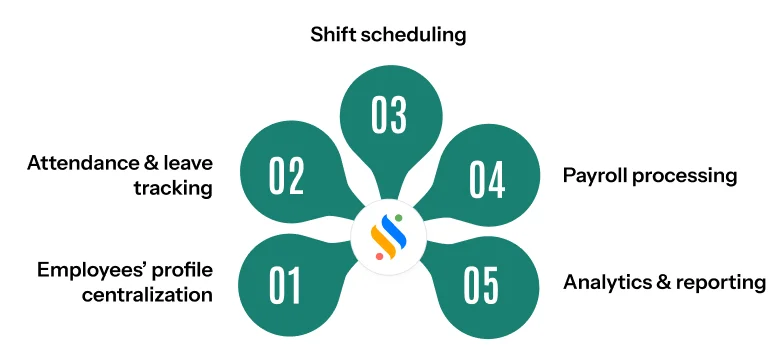
Centralization of employees’ profiles:
- The process begins when an employee profile is created.
- The platform acts as a secure platform.
- It stores personal details, salary structures, tax forms, and job tracking.
Attendance & leave tracking:
- The employee clocks in through a biometric device, mobile app, or a desktop system.
- The system automatically starts tracking their working hours, break time, and clock-out.
- In case of applying for leave, an employee can do it by applying in just a few clicks. The request flows to their manager for approval.
- Once approved, the leave balance updates instantly and the attendance record reflects it automatically.
Shift scheduling:
- HR or operations teams create and assign shifts within the system.
- Employees are notified of their upcoming schedules in advance.
- Any last-minute changes will also get handled and will get communicated to the employee promptly.
Payroll processing:
- At the end of every month, the payroll module pulls data on attendance, leave, and shifts automatically from the what is HRMS software.
- The payroll system calculates the gross salary, applies PF, ESIC, TDS, and professional tax deductions, and arrives at the net salary accurately.
- Employees can easily download their payslips.
- Statutory filings are also taken care of and submitted on time, keeping the business compliant.
Analytics & reporting:
- Managers and HR can easily generate real-time data and analytics straight from the dashboard.
- Custom report generation and compliance reports can also be done instantly, turning raw attendance data into actionable data-driven insights. This way, managers can look at the specific data and make accurate and informed decisions.